
Blue-Footed Booby in the Galápagos: Where to Watch Its Famous Dance
The most famous bird of the islands: why its feet are blue, how its high-stepping courtship dance works, where the colonies are and when to see chicks and dancing pairs.
5 min read
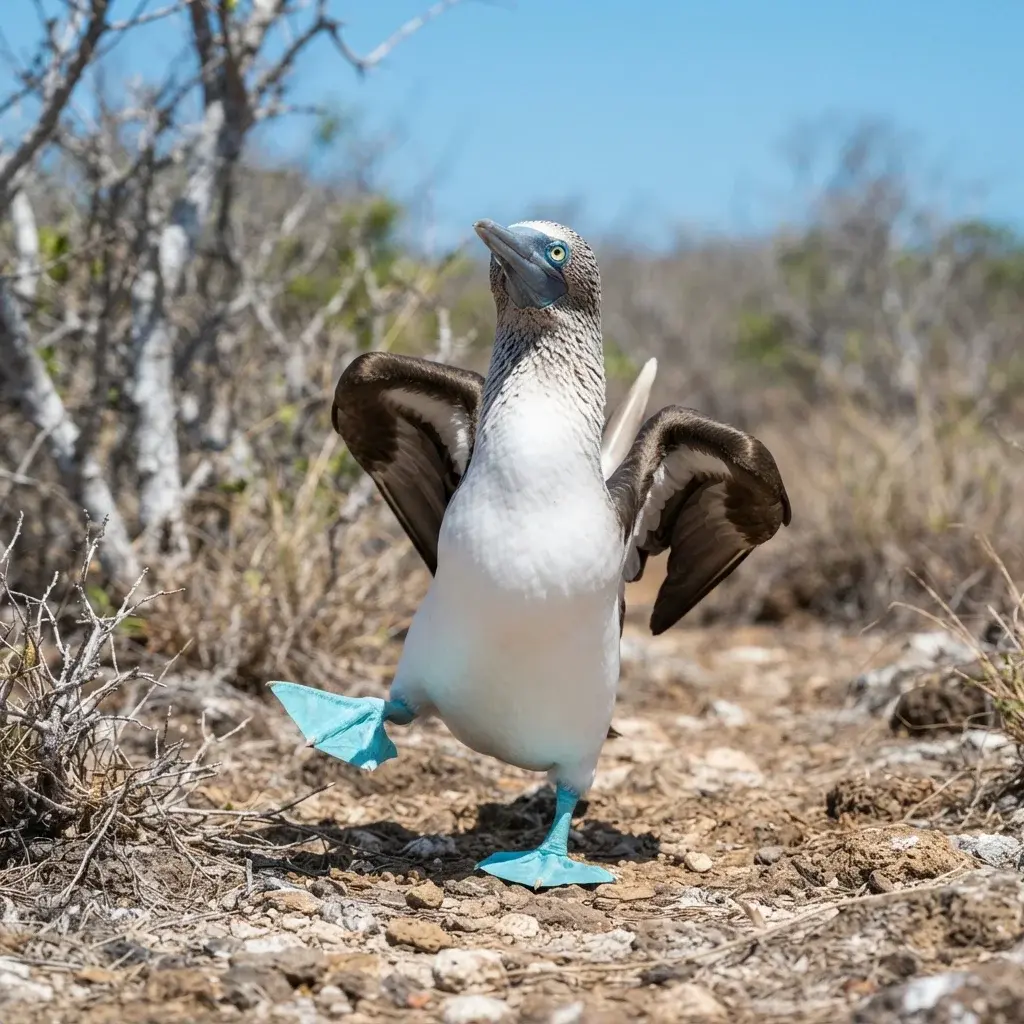
It is impossible not to smile at a blue-footed booby. A male lifts one bright blue foot, then the other, struts slowly around a female, spreads his wings and points his beak to the sky with a whistle. She answers with the same moves. This courtship dance, performed a few steps from the trail, is one of the most loved scenes of the Galápagos, and the bird itself has become the unofficial mascot of the islands.
Quick facts
| Fact | Blue-footed booby |
|---|---|
| Scientific name | Sula nebouxii |
| Endemic | No; it lives along the Pacific coast of the Americas, but the Galápagos has many of its colonies |
| Size | About 80 cm long, with a wingspan of around 1.5 m |
| Diet | Small fish such as sardines and anchovies, caught by plunge-diving |
| Conservation status | Least Concern (IUCN) |
| Best places to see them | North Seymour, Española and San Cristóbal |
| Best time | All year · courtship dances are especially common from June to August |
Why are their feet blue?
The colour comes from pigments in the fresh fish they eat. A well-fed, healthy booby has bright, turquoise-blue feet, while a hungry or older one has duller feet. Females pay close attention: during courtship the male shows off his feet, and the brighter they are, the better his chances. The colour changes quickly with diet, so it is an honest sign of how well a bird is doing.
The famous dance
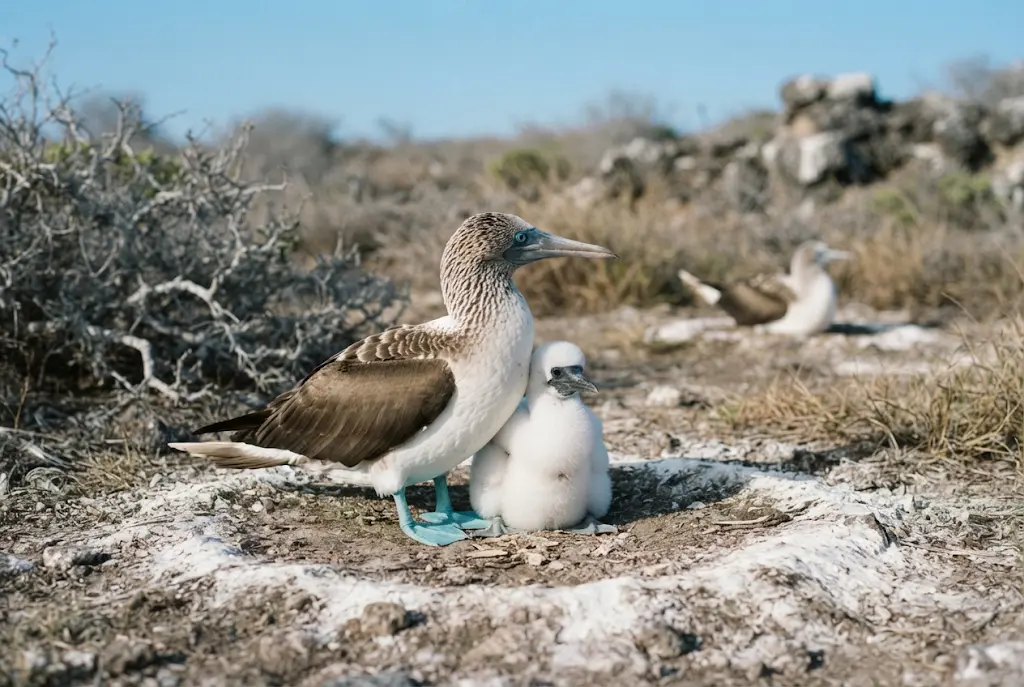
Courtship starts with the male parading in front of the female, lifting his feet in a slow, exaggerated march. Then comes sky-pointing: he raises his tail, opens his wings and points his beak upwards while whistling. Females answer with a deeper honk. Males also offer small sticks or stones, a symbolic gift, as they have no real nest. If the pair agrees, they will nest on the bare ground, inside a ring of white guano.
Expert divers
Blue-footed boobies fish by plunge-diving: they fly over the sea, spot a school of sardines, fold their wings and drop like arrows from many metres up, hitting the water at high speed. Sometimes whole groups dive together. Watching them from the yacht or from the shore is one of the great spectacles of the islands.
Where to see blue-footed boobies
- North Seymour: one of the best colonies, with dancing pairs and nests right by the trail, together with frigatebirds and land iguanas.
- Punta Suárez, Española: boobies nest among Nazca boobies and waved albatrosses, on the southern routes.
- Punta Pitt, San Cristóbal: one of the few places where you can see all three boobies of the islands.
- Isabela: large groups plunge-diving along the coast, on the western routes.
To find the yachts whose routes include these sites, see cruises by island, or locate each one on the interactive map.
Best time to see them
Blue-footed boobies can be seen all year round, and they breed whenever food is plentiful, so different colonies can be dancing, nesting or raising chicks at different times. Courtship dances are especially common from June to August, during the cool season, when the sea is rich in fish. Check the Galápagos wildlife calendar and our guide to the best time to visit.
Family life
The female lays one to three eggs on the ground, and both parents take turns to keep them warm with their feet. The chicks hatch a few days apart, and when food is scarce the oldest often survives at the expense of the youngest. The chicks are covered in white down and grow quickly; after a few months they fledge and learn to dive. Studies in recent years have found fewer breeding pairs in some seasons, linked to a shortage of sardines, which is why scientists keep a close eye on the colonies.
Tips for your visit
- Watch where you walk. Boobies often nest right next to or even on the trail. Your guide will lead you around them.
- Wait for the dance. If you see a male lifting his feet near a female, stop and wait: the full dance can last several minutes.
- Look at the sea. From the yacht, keep an eye out for groups of diving boobies, especially in the late afternoon.
How to watch them responsibly
- Keep at least two metres away from birds and nests.
- Never touch eggs or chicks, and never step inside a guano ring.
- Do not use flash, and avoid sudden movements near nesting pairs.
- Stay on the marked trail and follow your naturalist guide.
Frequently asked questions
Why do blue-footed boobies have blue feet?
The colour comes from pigments in the fresh fish they eat. Brighter feet show a healthier bird, and females prefer males with the bluest feet.
Where is the best place to see blue-footed boobies?
North Seymour, Punta Suárez on Española and Punta Pitt on San Cristóbal are the classic sites.
When do blue-footed boobies dance?
They can court at any time of year, but dances are especially common from June to August.
Are blue-footed boobies only found in the Galápagos?
No. They also live on the Pacific coast of the Americas, but the Galápagos is one of the best places in the world to see them.
Why are they called boobies?
The name comes from the Spanish word “bobo”, meaning silly, because of their clumsy walk on land and their lack of fear of people.
More Galápagos animals
Meet the other two boobies of the islands, the Nazca booby and the red-footed booby, and all the animals you can see on your trip, with the islands and months for each one, in our guide to Galápagos animals.
Yachts that visit them

M/C Monique
A 2026 hybrid catamaran for 16 guests, with ocean-view suites, an open-air jacuzzi and a near one-to-one crew.
From USD 7,500
View yacht
M/Y Grand Majestic
A 39-metre US-designed luxury motor yacht, launched in 2018 and reaching 25 knots, with a 39 m² master suite, seven staterooms and…
Private charter On request
View yacht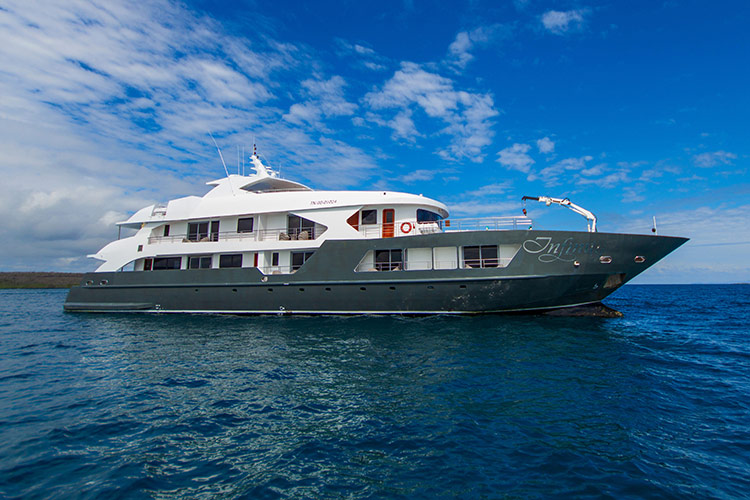
M/Y Infinity Expedition
A 49-metre luxury motor yacht launched in 2018, with eight double cabins and two suites, all with private balconies, a jacuzzi and…
Private charter On request
View yacht