
Galápagos Land Iguana: Where and When to See Them
The golden dragons of the islands: how they live among the cactus, where to see them up close, how the species was brought back to islands where it had disappeared, and how to watch them responsibly.
5 min read
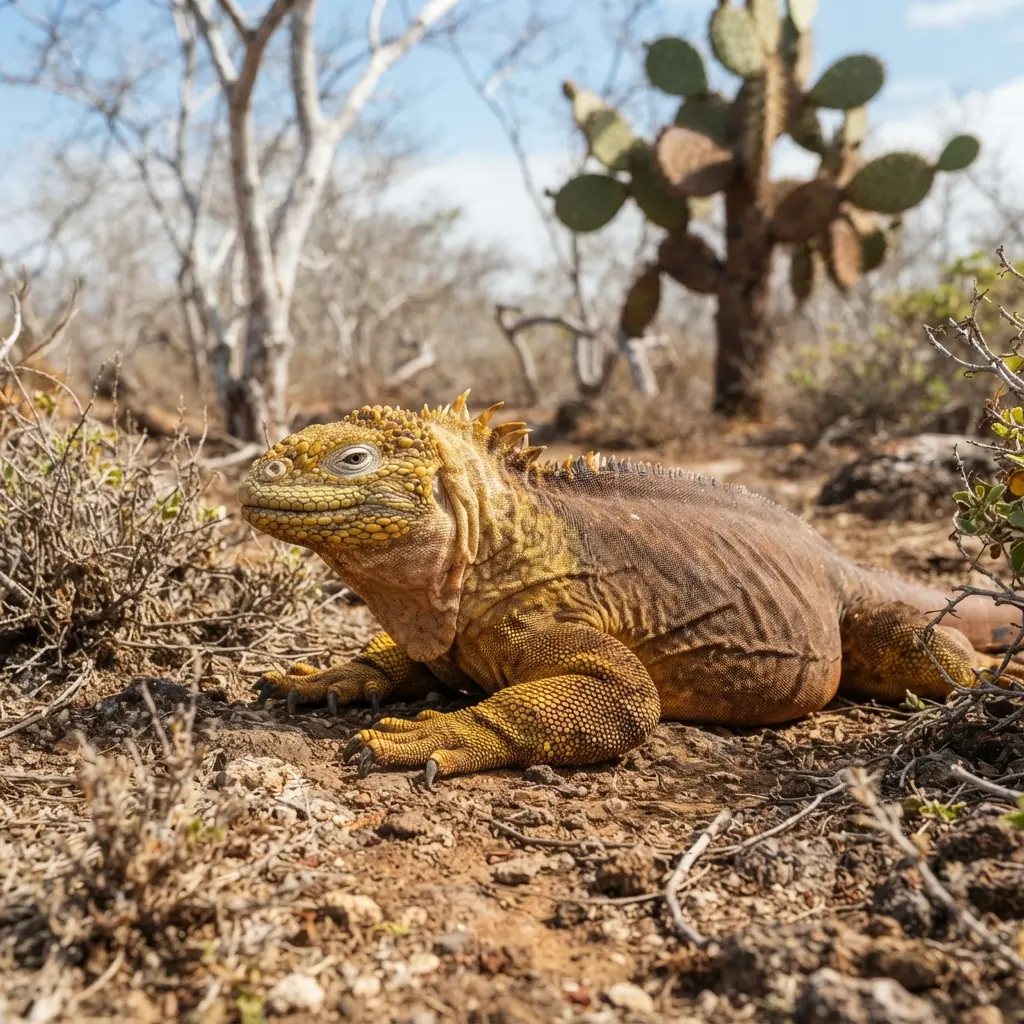
With their spiny crest, scaly skin and slow, deliberate walk, land iguanas look like small dragons left over from another age. On a hot afternoon you will find them lying motionless under a cactus, waiting for a pad or a ripe fruit to fall. They are one of the great sights of the central islands, and one of the clearest conservation success stories of the Galápagos.
Quick facts
| Fact | Galápagos land iguana |
|---|---|
| Scientific name | Conolophus subcristatus |
| Endemic | Yes, found only in the Galápagos |
| Size | Around 1 m long, including the tail |
| Weight | Large males can weigh more than 10 kg |
| Lifespan | Several decades; some may live 50 years or more |
| Diet | Mainly prickly pear cactus: pads, flowers and fruit |
| Conservation status | Vulnerable (IUCN) |
| Best place to see them | North Seymour and South Plaza |
| Best time | All year round |
Dragons of the cactus forest
Land iguanas live in the dry lowlands, where rain is scarce and the prickly pear cactus is king. They eat its pads, flowers and fruit, often spines and all, and the juicy cactus gives them most of the water they need, so they can go a long time without drinking. Some cactus on the islands grow tall, with tree-like trunks, as if to keep their pads out of the iguanas’ reach.
They are cold-blooded, so their day follows the sun: they bask in the morning, feed, and rest in the shade or in their burrows during the hottest hours. You may also see a small bird hopping on an iguana’s back. Darwin’s finches and mockingbirds pick ticks from their skin, and the iguanas often stand tall on their legs to let them do it.
Where to see land iguanas
The central islands are the best place to meet them:
- North Seymour: one of the easiest and most rewarding sites. Iguanas rest along the trail, among blue-footed boobies and frigatebirds.
- South Plaza: a small island covered in red ground plants in the dry season, with prickly pear cactus and a busy colony of yellow iguanas waiting under them.
- Dragon Hill, Santa Cruz: named after its iguanas, it is a site where the species was saved and brought back after its numbers fell sharply.
- Urbina Bay, Isabela: on some western routes, large and colourful iguanas live near the coast.
Santa Fe has its own, paler species, the Santa Fe land iguana. To find the yachts whose routes reach these islands, see cruises by island, or locate each site on the interactive map.

Best time to see them
Land iguanas can be seen all year round. Breeding times vary from island to island: males become more territorial and colourful when they defend their patch of ground, and females later dig their nests in soft soil and guard them for a while. In the warm season, when rain makes the cactus flower and fruit, iguanas are often very active, while in the dry season they gather under the cactus waiting for food to fall.
To combine them with other animals, check the Galápagos wildlife calendar and our guide to the best time to visit.
Three land iguanas
There are three species of land iguana in the Galápagos. The Galápagos land iguana is the most widespread. The Santa Fe land iguana lives only on Santa Fe. And the pink iguana, described by scientists only in 2009, lives only on the slopes of Wolf Volcano in northern Isabela, in an area closed to visitors. It is one of the rarest reptiles in the world. On South Plaza, land iguanas sometimes cross with marine iguanas, producing rare hybrids with features of both.
Back from the edge
Land iguanas suffered badly from animals brought by people. Goats ate the cactus and plants they need, while feral dogs, cats, pigs and rats killed adults and took eggs and young. Whole populations disappeared, such as those of Baltra and Santiago.
Luckily, in the 1930s a group of iguanas had been moved from Baltra to nearby North Seymour, where they thrived. Their descendants were later used to bring the species back to Baltra, and in 2019 more than a thousand iguanas from North Seymour were released on Santiago. On Santa Cruz and Isabela, breeding programmes at the Charles Darwin Research Station raised young iguanas and returned them to the wild. Today land iguanas are once again a common sight at many visitor sites.
Tips for your visit
- Look under the cactus. In the heat of the day iguanas rest in the shade of the prickly pear, often perfectly still. Your guide will spot many that you would walk past.
- Bring a zoom. They let you come close, but a short telephoto lens lets you fill the frame with their face and crest from the required distance.
- Protect yourself from the sun. The sites where land iguanas live are dry and open, with little shade. A hat, sunscreen and water make the walk much more pleasant.
How to watch them responsibly
- Keep at least two metres away and never block an iguana’s path.
- Do not touch or feed them, and never offer cactus or fruit.
- Stay on the marked trails: burrows and nests can be under the ground beside them.
- Follow your naturalist guide, who knows each site and its rules.
Frequently asked questions
What is the difference between land iguanas and marine iguanas?
Land iguanas are larger, yellowish and live on land, eating cactus. Marine iguanas are dark, smaller and feed on algae in the sea. Both are found only in the Galápagos.
Are land iguanas dangerous?
No. They are calm herbivores and usually ignore visitors. As with all wildlife in the islands, you should simply keep your distance.
Where is the best place to see land iguanas?
North Seymour and South Plaza, near Santa Cruz, are the easiest sites, and Dragon Hill on Santa Cruz is another classic. Many itineraries of the central islands include at least one of them.
Can I see the pink iguana?
No. The pink iguana lives only on Wolf Volcano, in northern Isabela, in a protected area that is closed to visitors.
Why do land iguanas eat cactus?
The prickly pear cactus is the most reliable food in the dry lowlands, and it also provides most of the water they need in a place where fresh water is rare.
More Galápagos animals
In the same places you are likely to see blue-footed boobies, frigatebirds, swallow-tailed gulls and Darwin’s finches. Discover all of them, with the islands and months to see each one, in our guide to Galápagos animals.
Yachts that visit them

M/C Monique
A 2026 hybrid catamaran for 16 guests, with ocean-view suites, an open-air jacuzzi and a near one-to-one crew.
From USD 7,500
View yacht
M/Y Grand Majestic
A 39-metre US-designed luxury motor yacht, launched in 2018 and reaching 25 knots, with a 39 m² master suite, seven staterooms and…
Private charter On request
View yacht
M/Y Infinity Expedition
A 49-metre luxury motor yacht launched in 2018, with eight double cabins and two suites, all with private balconies, a jacuzzi and…
Private charter On request
View yacht