
Nazca Booby: The Masked Seabird of the Galápagos Cliffs
The largest booby of the islands, snow-white with a black mask: how to recognise it, where it nests on the cliffs, its surprising family life and the best places to watch it.
4 min read
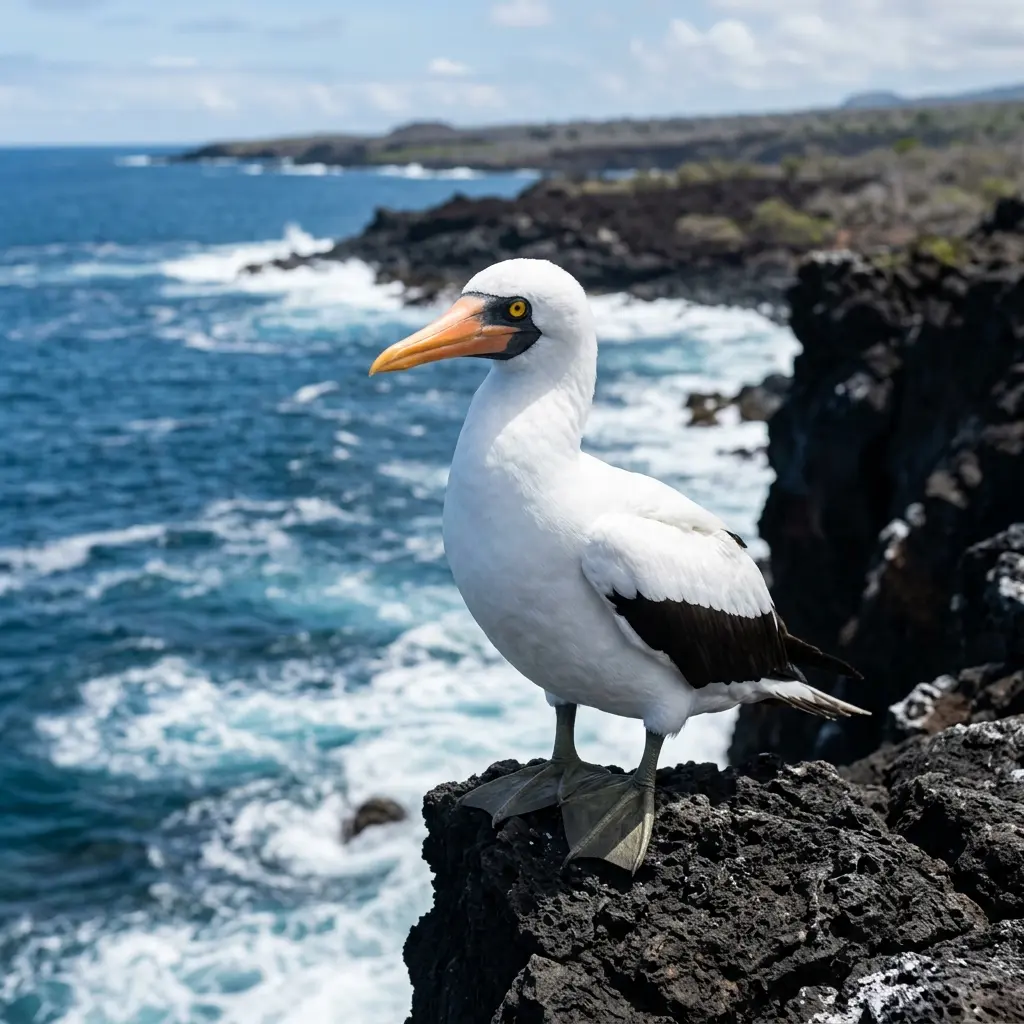
Standing on the edge of a cliff, bright white against the dark lava and the deep blue sea, the Nazca booby looks almost formal, as if dressed for an occasion. It is the largest of the boobies of the Galápagos and the most elegant, and on islands like Española you will walk among its nests, a few steps from birds that calmly watch you go by.
Quick facts
| Fact | Nazca booby |
|---|---|
| Scientific name | Sula granti |
| Endemic | No; it lives in the eastern Pacific, with large colonies in the Galápagos |
| Size | Around 80 to 90 cm long, wingspan of about 1.6 m |
| Diet | Fish such as sardines and flying fish, caught by plunge-diving farther out at sea |
| Conservation status | Least Concern (IUCN) |
| Best places to see them | Española and Genovesa |
| Best time | All year round; nesting times vary between islands |
How to recognise it
The Nazca booby is mostly bright white, with black edges on the wings and tail and a black mask of bare skin around the eyes and the base of the bill. The bill is orange-yellow, the eyes are yellow and the feet are dark grey-olive, very different from the colourful feet of its relatives. For a long time it was considered a form of the masked booby, until scientists recognised it as a separate species in the early 2000s.
A tough start in life
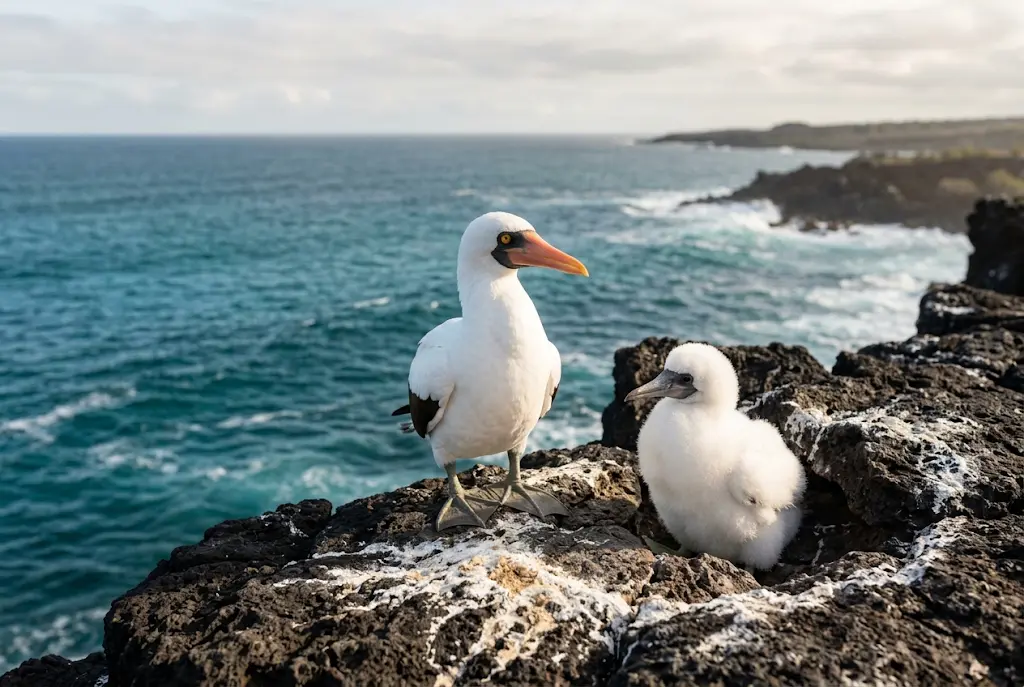
Nazca boobies usually lay two eggs a few days apart, but they almost always raise only one chick. The second egg is a kind of insurance: if the first fails, the second takes its place. If both hatch, the older chick pushes its younger sibling out of the nest ring, and the parents do not intervene. It sounds harsh, but it is an adaptation to a place where food can suddenly become scarce. The surviving chick, covered in white down, grows quickly and can be seen at the nest for months.
Where to see Nazca boobies
- Punta Suárez, Española: large colonies on the cliff tops, along the trail, together with blue-footed boobies and, from April to December, waved albatrosses, on the southern routes.
- Genovesa: Nazca boobies nest near the cliffs of Prince Philip’s Steps, among storm petrels and red-footed boobies, on northern routes.
- Punta Pitt, San Cristóbal: one of the few places where all three boobies of the islands can be seen.
To find the yachts whose routes include these sites, see cruises by island, or locate each one on the interactive map.
Best time to see them
Nazca boobies are in the islands all year round. Each colony has its own breeding rhythm, and the timing changes between islands and from year to year, so on most visits you will see adults at the nests, eggs or chicks. Combine them with other seabirds using the Galápagos wildlife calendar and our guide to the best time to visit; if you want to see albatrosses on Española too, plan your trip between April and December.
Expert fishers of the open sea
Nazca boobies fish farther from the coast than blue-footed boobies and can dive deeper, plunging from great height into the sea after sardines and flying fish. That is why you often see them flying far over open water as the yacht crosses between islands. Their colonies are healthy and the species is not threatened, although, like all seabirds of the islands, they suffer in El Niño years when fish become scarce.
Tips for your visit
- Look at the cliff edges. Nazca boobies like to nest close to the drop, where they can take off with the wind.
- Bring a zoom for portraits. Their black mask and yellow eyes make beautiful close-ups from the trail.
- Watch your step. Nests are on the bare ground, often next to the trail, and chicks can be anywhere.
How to watch them responsibly
- Keep at least two metres away from birds and nests.
- Never touch eggs or chicks, even if one seems abandoned.
- Stay on the marked trail and avoid the cliff edges.
- Follow your naturalist guide’s instructions at all times.
Frequently asked questions
What is the difference between a Nazca booby and a blue-footed booby?
The Nazca booby is larger and bright white, with a black mask, an orange-yellow bill and dark feet. The blue-footed booby is brown and white, with bright blue feet.
Where is the best place to see Nazca boobies?
Punta Suárez on Española and Genovesa are the classic sites.
Why do Nazca boobies raise only one chick?
They lay two eggs as insurance, but when both hatch the older chick pushes the younger one out of the nest. It is a strategy for a place where food can run short.
Are Nazca boobies endemic to the Galápagos?
No. They also nest on other islands of the eastern Pacific, but the Galápagos has some of their largest colonies.
When can I see Nazca booby chicks?
Breeding times vary between islands, so there are usually chicks in some colony at any time of year.
More Galápagos animals
On the same cliffs you will see swallow-tailed gulls, red-billed tropicbirds and, on Española, marine iguanas. Discover all of them, with the islands and months to see each one, in our guide to Galápagos animals.
Yachts that visit them

M/C Monique
A 2026 hybrid catamaran for 16 guests, with ocean-view suites, an open-air jacuzzi and a near one-to-one crew.
From USD 7,500
View yacht
M/Y Grand Majestic
A 39-metre US-designed luxury motor yacht, launched in 2018 and reaching 25 knots, with a 39 m² master suite, seven staterooms and…
Private charter On request
View yacht
M/Y Infinity Expedition
A 49-metre luxury motor yacht launched in 2018, with eight double cabins and two suites, all with private balconies, a jacuzzi and…
Private charter On request
View yacht