
Red-Footed Booby: Why Genovesa Is the Place to See It
The smallest booby of the islands and the only one that nests in trees: how to recognise it, why Genovesa is its kingdom, how it fishes far out at sea and how to plan your visit.
4 min read
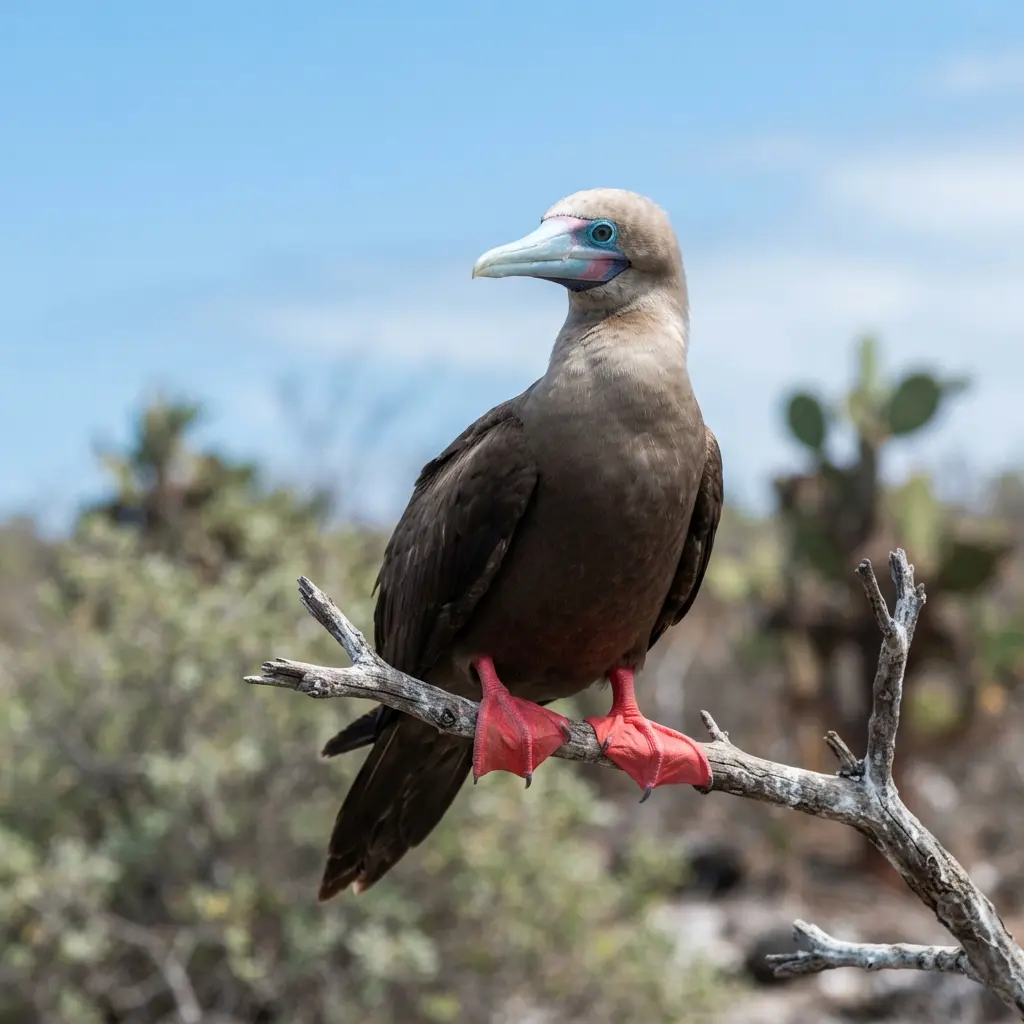
On Genovesa, the bushes and mangroves along the trail are full of birds. Look closer and you will see that many of them are boobies, perched on branches with their bright red feet wrapped around the twigs. The red-footed booby is the only booby that lives in trees, and Genovesa, far to the north-east of the archipelago, is one of the best places on Earth to see it.
Quick facts
| Fact | Red-footed booby |
|---|---|
| Scientific name | Sula sula |
| Endemic | No; it lives on tropical islands around the world |
| Size | Around 70 cm long, wingspan of about 1.4 m: the smallest booby |
| Diet | Flying fish and squid, caught far out at sea |
| Conservation status | Least Concern (IUCN) |
| Best places to see them | Genovesa and Punta Pitt on San Cristóbal |
| Best time | All year round |
How to recognise it
The feet give it away: bright red, almost coral. The bill is pale blue with a pink base, and the eyes are surrounded by blue skin. Red-footed boobies come in two colour forms. In the Galápagos most are brown, with a lighter head and tail, but a few are white with black wing tips, and both forms can nest side by side. They are smaller and slimmer than the other boobies, with long wings made for flying great distances.
A booby that lives in trees
Unlike their relatives, which nest on the bare ground, red-footed boobies build real nests of twigs in trees and shrubs, and their feet are adapted to grip branches. Because they fish far out at sea, often away from the islands where other seabirds hunt, they avoid competing with the blue-footed and Nazca boobies. They often head out at dawn and return at dusk, chased on the way home by frigatebirds trying to steal their catch.
Where to see red-footed boobies
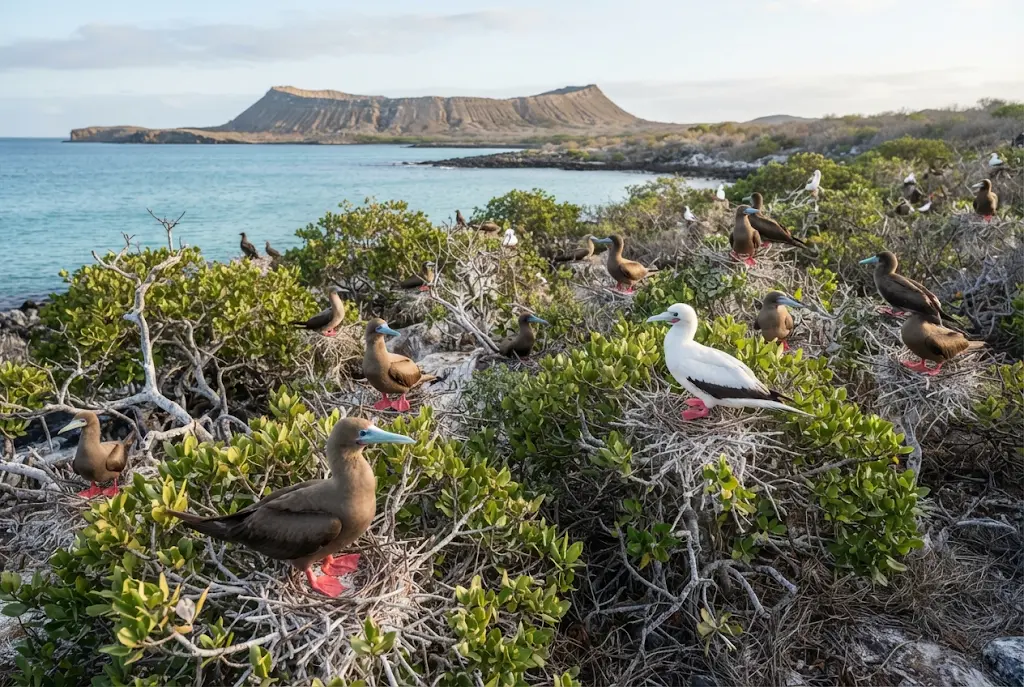
- Genovesa: the kingdom of the red-footed booby. At Darwin Bay the trail winds through salt bushes and mangroves full of nests, and at Prince Philip’s Steps they perch in the palo santo trees. Genovesa is visited on northern routes.
- Punta Pitt, San Cristóbal: one of the few sites where you can see all three boobies of the islands together.
Since Genovesa is far from the other islands, only some itineraries include it. To find the yachts whose routes reach it, see cruises by island, or locate it on the interactive map.
Best time to see them
Red-footed boobies can be seen all year round on Genovesa, with nests, eggs and chicks at different times. The crossing to Genovesa is usually smoother in the warm season, from December to May, when the sea is calmer, but the colony is spectacular in any month. Check the Galápagos wildlife calendar and our guide to the best time to visit.
Genovesa, the bird island
Genovesa is a low, horseshoe-shaped island formed by a collapsed volcano, with a flooded crater that makes Darwin Bay. With no Galápagos hawks and few predators on land, it hosts huge colonies of seabirds: red-footed and Nazca boobies, frigatebirds, swallow-tailed gulls and storm petrels, hunted by the short-eared owl. For bird lovers, it is one of the highlights of the Galápagos.
Tips for your visit
- Look up into the branches. On Genovesa the nests are at eye level or just above it, so walk slowly and scan the bushes.
- Be ready for steps. Prince Philip’s Steps is a steep rocky stairway from the dinghy landing; it is short but needs good shoes.
- Find a white one. Most red-footed boobies here are brown; spotting one of the rare white birds is a nice challenge.
How to watch them responsibly
- Keep at least two metres away from birds and nests, even when they are right by the trail.
- Never touch branches with nests or try to move them for a photo.
- Do not use flash and avoid sudden movements.
- Stay on the marked trail and follow your naturalist guide.
Frequently asked questions
Where is the best place to see red-footed boobies in the Galápagos?
Genovesa, which has one of the largest colonies in the world. Punta Pitt on San Cristóbal is another option.
Why do red-footed boobies nest in trees?
Their feet are adapted to grip branches, and nesting in trees and shrubs lets them use places where other boobies cannot nest.
Are all red-footed boobies brown?
No. In the Galápagos most are brown, but there is also a white form with black wing tips.
Is Genovesa included on every cruise?
No. It is far from the central islands and only some itineraries include it, so tell us if it is a priority.
Are red-footed boobies endangered?
No. They are widespread on tropical islands worldwide and are listed as Least Concern.
More Galápagos animals
On Genovesa you can also see swallow-tailed gulls, red-billed tropicbirds and fur seals. Discover all of them, with the islands and months to see each one, in our guide to Galápagos animals.
Yachts that visit them

M/C Monique
A 2026 hybrid catamaran for 16 guests, with ocean-view suites, an open-air jacuzzi and a near one-to-one crew.
From USD 7,500
View yacht
M/Y Grand Majestic
A 39-metre US-designed luxury motor yacht, launched in 2018 and reaching 25 knots, with a 39 m² master suite, seven staterooms and…
Private charter On request
View yacht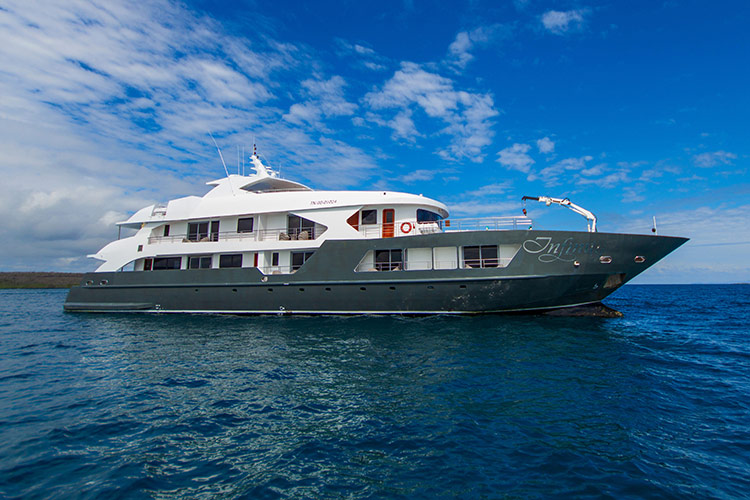
M/Y Infinity Expedition
A 49-metre luxury motor yacht launched in 2018, with eight double cabins and two suites, all with private balconies, a jacuzzi and…
Private charter On request
View yacht