
Galápagos Marine Iguana: Where and When to See Them
The only lizard in the world that feeds in the sea: how it lives between lava and ocean, where to see the great colonies, when they change colour and how to watch them up close.
6 min read
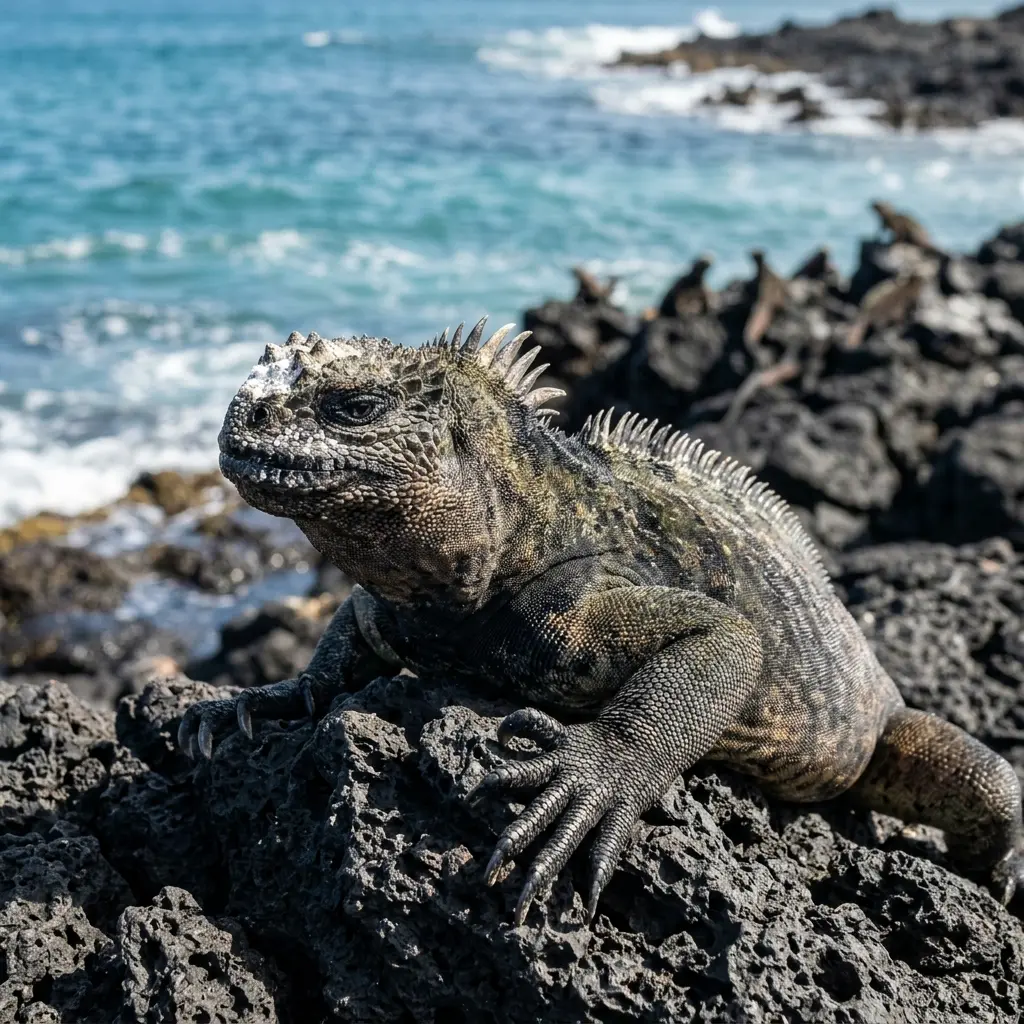
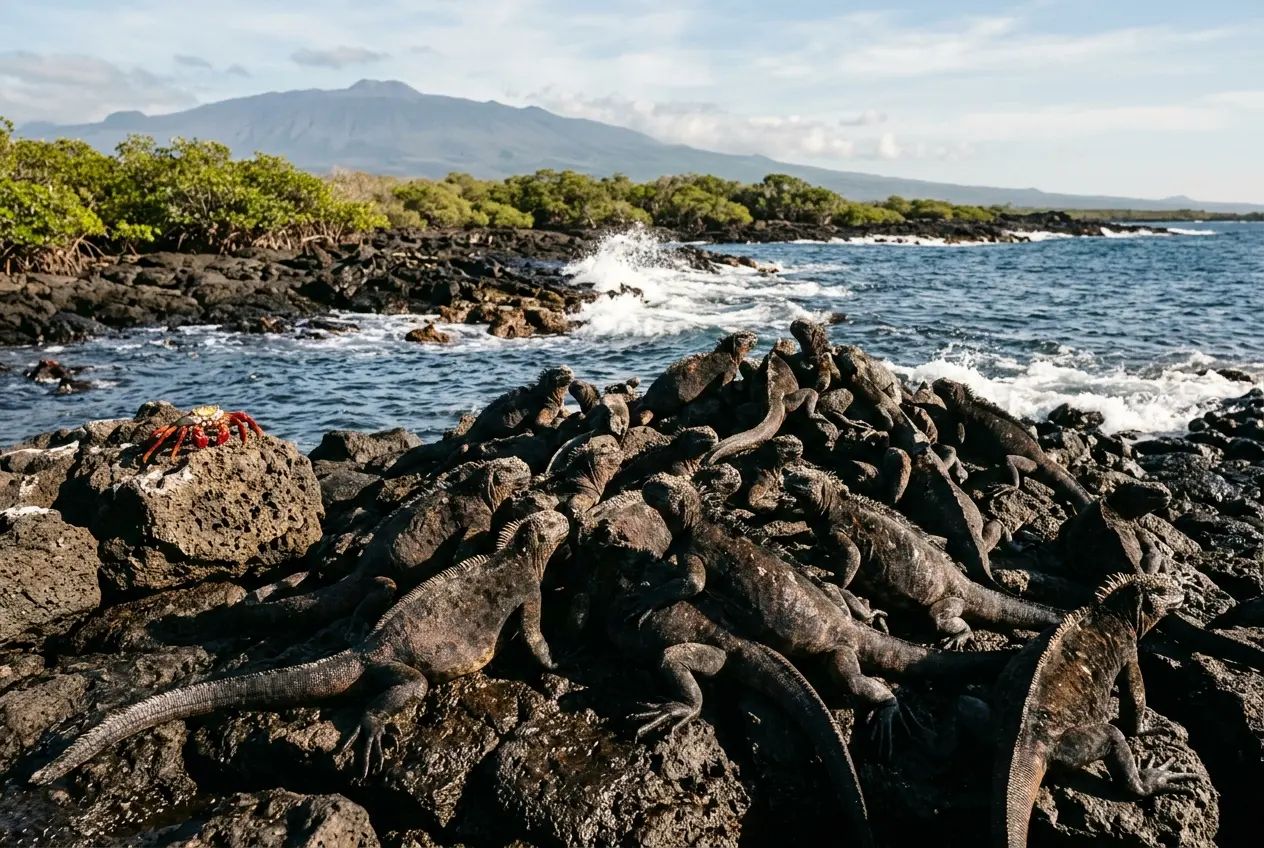
Charles Darwin was not impressed when he first saw them in 1835: he called them “imps of darkness”. Yet the marine iguana is one of the most extraordinary animals on the planet. No other lizard lives from the sea. Every day it leaves the warm lava, swims into the cold Pacific to graze on seaweed and comes back to lie in the sun, often in colonies of hundreds, piled on top of each other like a living part of the rock.
Quick facts
| Fact | Marine iguana |
|---|---|
| Scientific name | Amblyrhynchus cristatus |
| Endemic | Yes, found only in the Galápagos |
| Size | From about 0.5 m on small islands to more than 1.3 m on Fernandina and Isabela |
| Weight | From under 1 kg to around 12 kg in the largest males |
| Diet | Marine algae |
| Conservation status | Vulnerable (IUCN) |
| Best place to see them | Fernandina and western Isabela |
| Best time | All year · colours peak in December and January · nesting from January to April |
A lizard that lives from the sea
Marine iguanas feed almost only on algae that grow on the rocks below and around the tide line. The smaller iguanas graze on the rocks uncovered at low tide, while the large males swim out and dive, holding onto the seabed with their strong claws and tearing the algae with their short, blunt snouts. A flattened tail works like an oar.
The water around the islands is cold, and a cold lizard is a slow one. That is why marine iguanas spend most of the day basking: their dark skin soaks up the heat of the sun and of the black lava, and only when their body is warm again can they return to the sea. You will often see them sneeze a fine spray: special glands near the nose remove the extra salt they swallow while feeding.
Where to see marine iguanas
They live on the coasts of almost every island, but some sites are unforgettable:
- Punta Espinoza, Fernandina: the largest colonies of the archipelago. Hundreds of iguanas cover the lava, so close to the trail that your guide will ask you to watch where you step. It is on the western routes.
- Western Isabela: sites such as Punta Vicente Roca, Urbina Bay and Punta Moreno have big, dark iguanas, and in the cool water you can sometimes snorkel beside them while they feed.
- Punta Suárez, Española: home of the most colourful iguanas in the islands, the famous “Christmas iguanas”, on the southern routes.
- Puerto Egas, Santiago: iguanas share the black lava shore with fur seals and Sally Lightfoot crabs.
- Tortuga Bay, Santa Cruz: a long white beach where iguanas cross the sand to reach the sea.
To find the yachts whose routes reach these islands, see cruises by island, or locate each site on the interactive map.
Best time to see them
Marine iguanas can be seen all year round. The most colourful moment is the breeding season: around December and January, the males of Española turn bright red and green, and males on other islands also darken and gain colour as they defend their small territories on the rocks. From January to April, females dig their nests in sandy ground and guard them for a few days; the young hatch some three to four months later.
In the cool season, from June to November, the sea is richer and colder, and you are more likely to see large iguanas feeding while snorkelling in the west. To combine them with other animals, check the Galápagos wildlife calendar and our guide to the best time to visit.
Why they look different on each island
Marine iguanas arrived in the Galápagos millions of years ago and, over time, each group of islands shaped its own form. Scientists recognise several subspecies. Those of Fernandina and Isabela are the largest and darkest; those of Genovesa are tiny; and those of Española are the most colourful of all. Their size even follows the food: in El Niño years, when warm water kills the algae, many iguanas starve, and the survivors can actually become shorter, shrinking their bodies to need less food, then growing again when the algae return.
Threats and conservation
The marine iguana is listed as Vulnerable. Its biggest natural threat is El Niño, which can wipe out large parts of a colony in a single bad year. Introduced cats, dogs and rats take eggs and young iguanas, and pollution near the inhabited islands is a growing concern. The Galápagos National Park controls introduced predators and protects the main nesting areas, and visitors help simply by staying on the trails and keeping their distance.
Tips for your visit
- Watch your step. On Fernandina and Española iguanas lie right on the trail and blend with the lava. Walk slowly and look down before every step.
- Time it with the tide. At low tide the smaller iguanas graze on the uncovered rocks, which is the easiest moment to watch them feed from land.
- Bring a good wetsuit. The best snorkelling with iguanas is in the cool western waters, where a 5 mm wetsuit makes a long swim far more comfortable.
How to watch them responsibly
- Keep at least two metres away, even when they are lying across the trail.
- Never touch them or block their way to the sea.
- In the water, float calmly and let them feed: do not chase or follow them.
- Stay with your naturalist guide, who knows where the nests are in the breeding season.
Frequently asked questions
Are marine iguanas dangerous?
No. They are calm herbivores that feed only on algae. They may look fierce, but they ignore people as long as you keep your distance.
Why do marine iguanas sneeze?
To get rid of salt. Glands near the nose filter the extra salt from the seawater they swallow while feeding, and they blow it out in a fine spray.
Can you snorkel with marine iguanas?
Yes, at some sites of western Isabela and Fernandina, where large males feed underwater. It depends on the route and on the conditions, so ask us which itineraries include those snorkelling sites.
Why are some marine iguanas red and green?
That is the breeding colour of the males of Española, strongest around December and January. Their diet of certain algae gives them those bright tones.
Do marine iguanas live anywhere else?
No. They are found only in the Galápagos Islands, and they are the only lizards in the world that feed in the sea.
More Galápagos animals
Along the same shores you are likely to meet Sally Lightfoot crabs, sea lions and, in the west, flightless cormorants and Galápagos penguins. On land, their cousins are the land iguanas. Discover all of them, with the islands and months to see each one, in our guide to Galápagos animals.
Yachts that visit them
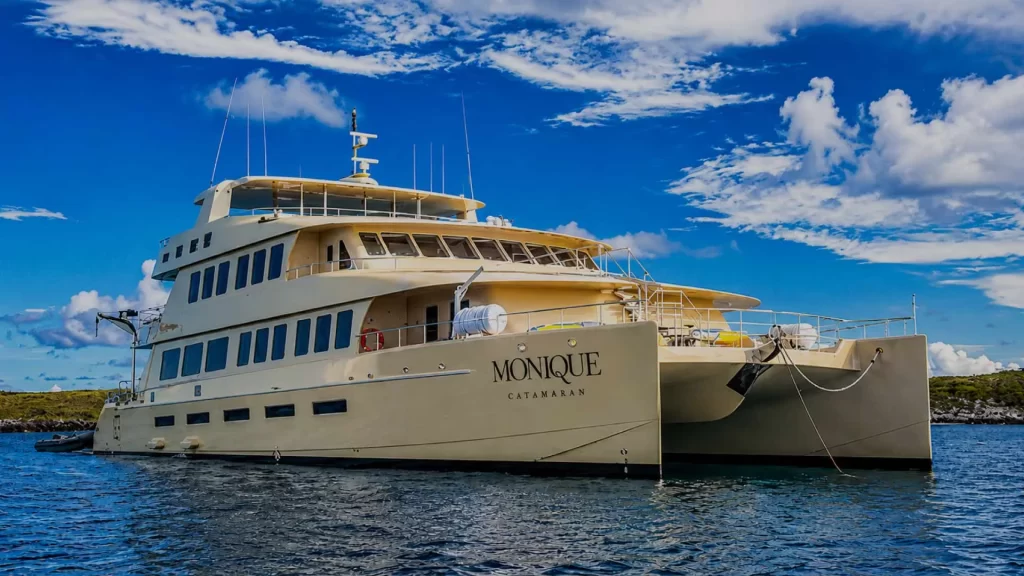
M/C Monique
A 2026 hybrid catamaran for 16 guests, with ocean-view suites, an open-air jacuzzi and a near one-to-one crew.
From USD 7,500
View yacht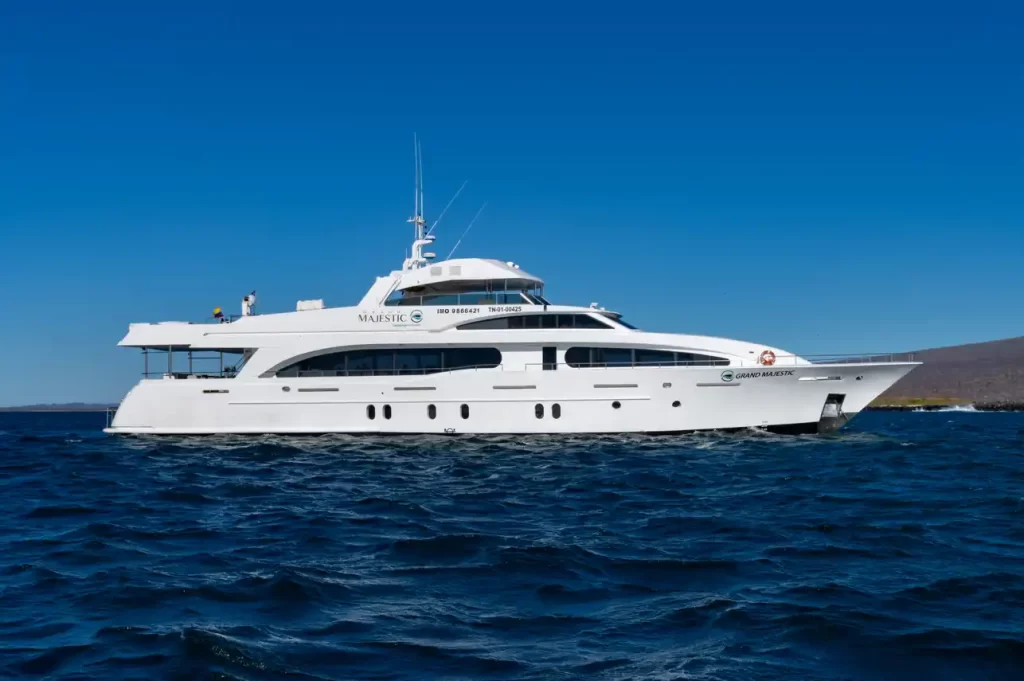
M/Y Grand Majestic
A 39-metre US-designed luxury motor yacht, launched in 2018 and reaching 25 knots, with a 39 m² master suite, seven staterooms and…
Private charter On request
View yacht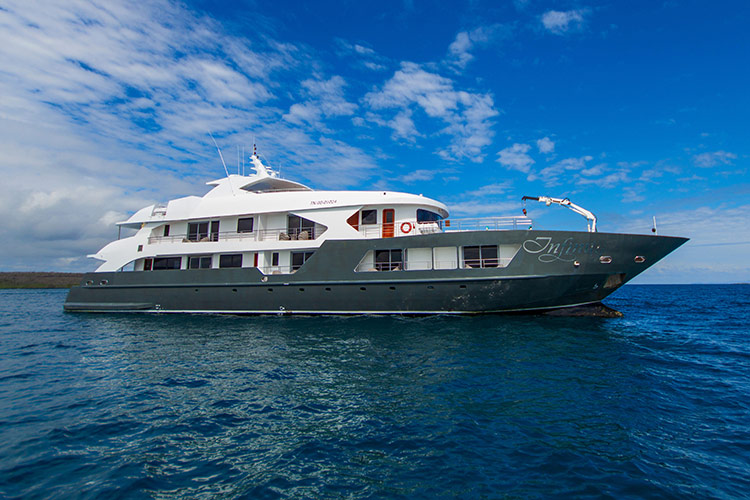
M/Y Infinity Expedition
A 49-metre luxury motor yacht launched in 2018, with eight double cabins and two suites, all with private balconies, a jacuzzi and…
Private charter On request
View yacht