
Swallow-Tailed Gull: The World’s Only Night-Hunting Gull
A gull with a red eye ring that fishes in the dark: how the swallow-tailed gull hunts at night, where it nests on the cliffs of the Galápagos and why it is one of the most elegant birds you will see on your trip.
4 min read
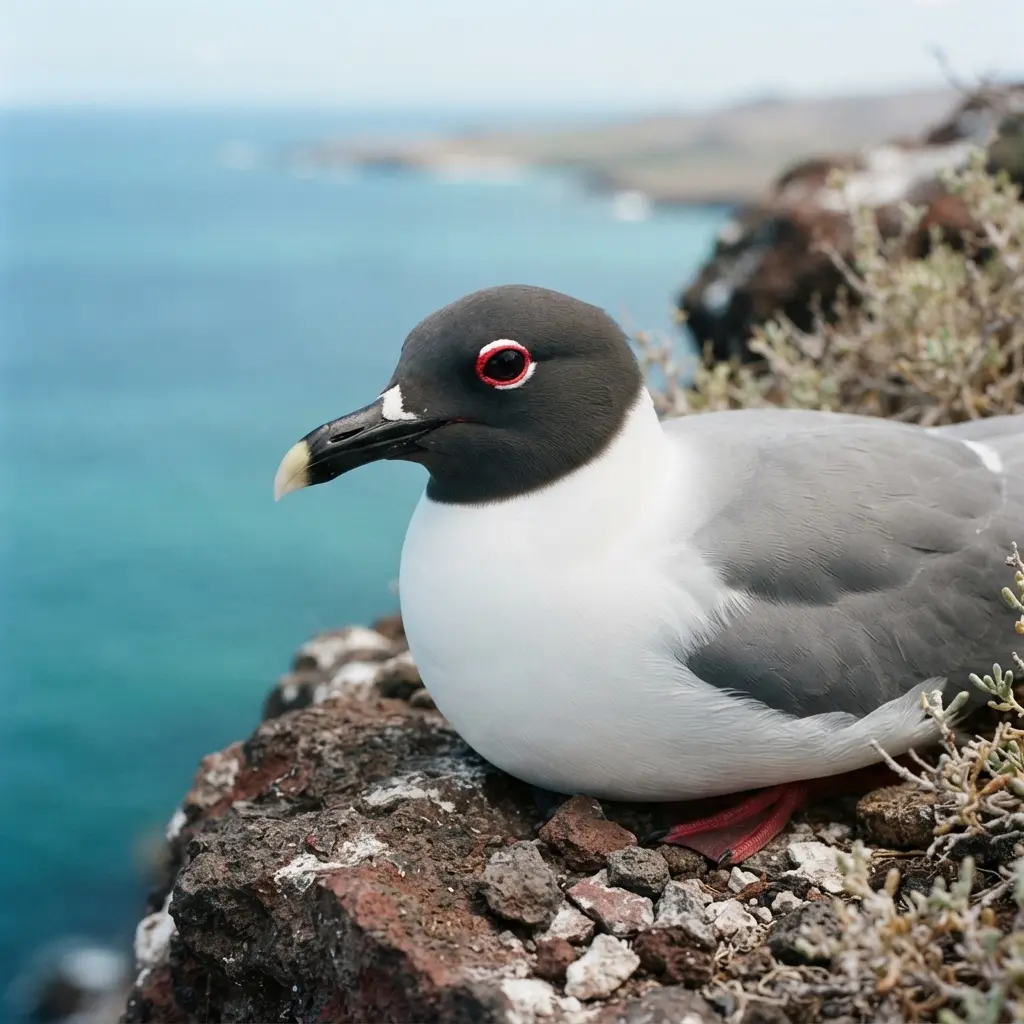
On the cliffs of South Plaza, while sea lions sleep on the rocks below, elegant gulls sit on the ledges with a scarlet ring around very large eyes. As the light fades, they take off and head out to sea. The swallow-tailed gull is the only gull in the world that hunts at night, and nearly all of them nest in the Galápagos.
Quick facts
| Fact | Swallow-tailed gull |
|---|---|
| Scientific name | Creagrus furcatus |
| Endemic | Almost: it breeds in the Galápagos, with only a few pairs on Malpelo, Colombia |
| Wingspan | Around 1.3 m |
| Diet | Squid and small fish caught at night near the surface |
| Conservation status | Least Concern (IUCN) |
| Best places | South Plaza, Genovesa, Española and North Seymour |
| Best time | All year round |
A gull that hunts in the dark
Most gulls feed by day, often around boats and beaches. The swallow-tailed gull does the opposite: it leaves the colony at dusk and flies far out to sea, where squid and small fish rise to the surface at night. Its eyes are much larger than those of other gulls, which helps it see in low light. It also has a white spot at the base of its beak, which is thought to help the chicks find the beak in the dark when the parents return to feed them.
How to recognise it
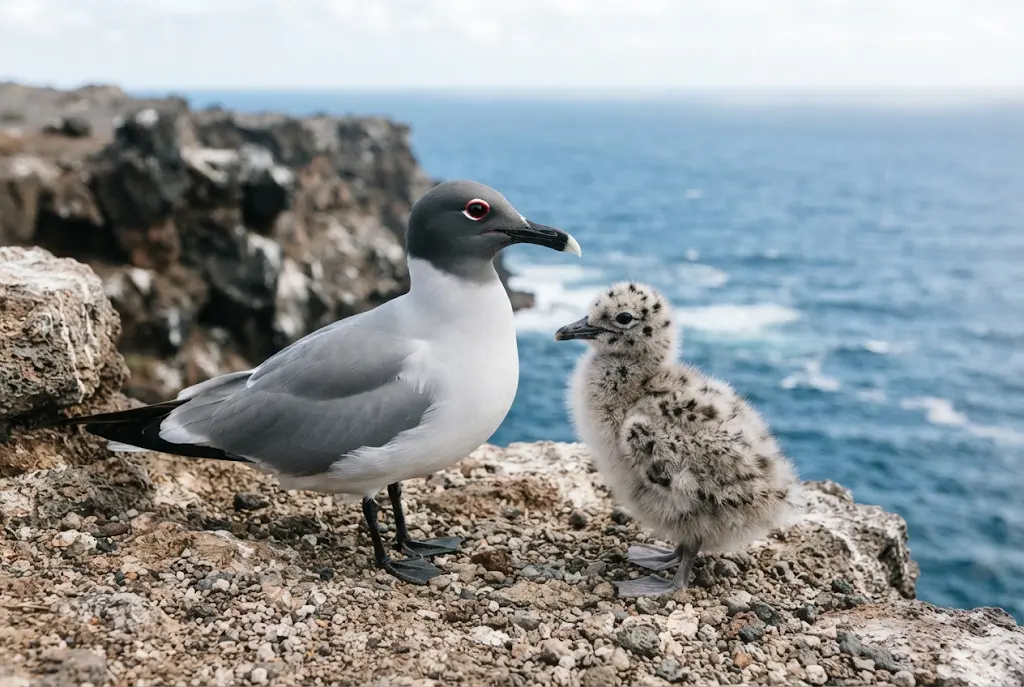
During the breeding season, adults have a dark grey to black head, a bright red ring around the eye, red feet and a black beak with a pale tip. The body is grey and white, and the tail is deeply forked, which gives the bird its name. Outside the breeding season the head becomes white with a dark patch around the eye. In flight, it looks graceful and light, with a pattern of grey, black and white on the wings. Its calls, a mix of rattles and whistles, are one of the typical sounds of the cliffs.
Life on the cliffs
Swallow-tailed gulls nest on cliffs and rocky ledges, usually close to the sea, sometimes on small beaches of stones. Each pair lays a single egg, often in a small ring of pebbles or pieces of coral. Both parents incubate the egg and feed the chick, and they can breed in any month of the year, often again less than a year after the previous nest. Outside the breeding season, many leave the islands and spend time at sea off the coasts of Ecuador and Peru.
Where to see swallow-tailed gulls
- South Plaza: the cliff at the end of the trail is full of nesting gulls, with land iguanas and red-billed tropicbirds nearby, on the central islands.
- Genovesa: gulls nest on the beach at Darwin Bay and along the cliffs of Prince Philip’s Steps, on the northern routes.
- Española: at Punta Suárez, gulls nest along the cliffs near Nazca boobies and waved albatrosses, on the southern islands.
- North Seymour: a few pairs nest along the rocky coast.
To find the yachts whose routes include these sites, see cruises by island, or locate each one on the interactive map.
Best time to see them
Swallow-tailed gulls are present all year round, and since each pair follows its own rhythm, you can see eggs, chicks and courting adults in almost any month. They are easiest to see during the day, resting on the cliffs before their night trip. Check the Galápagos wildlife calendar and our guide to the best time to visit.
Tips for your visit
- Look at the cliff edges. The gulls usually rest on ledges at eye level, perfect for close-up portraits.
- Stay until late afternoon. If your yacht is anchored near a colony, watch them leave for the sea at dusk.
- Watch your step. Eggs and chicks are often laid on bare rock, very close to the trail.
How to watch them responsibly
- Keep at least two metres away from nests and chicks.
- Never touch eggs or pebbles around a nest.
- Do not use flash, especially at dusk.
- Stay on the marked trail and follow your naturalist guide.
Frequently asked questions
Why is the swallow-tailed gull special?
It is the only gull in the world that hunts at night, and almost all of them nest in the Galápagos.
Where can I see swallow-tailed gulls?
On the cliffs of South Plaza, Genovesa, Española and North Seymour.
Why does it have a red ring around its eye?
It is part of its breeding plumage and is used in courtship; the large eyes themselves help it see at night.
What does the swallow-tailed gull eat?
Mostly squid and small fish, caught at night near the surface of the sea.
When do swallow-tailed gulls nest?
All year round. Each pair has its own cycle, so you can see eggs and chicks in almost any month.
More Galápagos animals
On the same cliffs you can see red-billed tropicbirds, frigatebirds and short-eared owls. Discover all of them, with the islands and months to see each one, in our guide to Galápagos animals.
Yachts that visit them

M/C Monique
A 2026 hybrid catamaran for 16 guests, with ocean-view suites, an open-air jacuzzi and a near one-to-one crew.
From USD 7,500
View yacht
M/Y Grand Majestic
A 39-metre US-designed luxury motor yacht, launched in 2018 and reaching 25 knots, with a 39 m² master suite, seven staterooms and…
Private charter On request
View yacht
M/Y Infinity Expedition
A 49-metre luxury motor yacht launched in 2018, with eight double cabins and two suites, all with private balconies, a jacuzzi and…
Private charter On request
View yacht