
Galápagos Mockingbirds: The Curious Birds That Inspired Darwin
Four species, each on its own islands, and so curious they will inspect your shoes and your water bottle: how the mockingbirds of the Galápagos gave Darwin his first clue, how to tell them apart and where to see each one.
4 min read
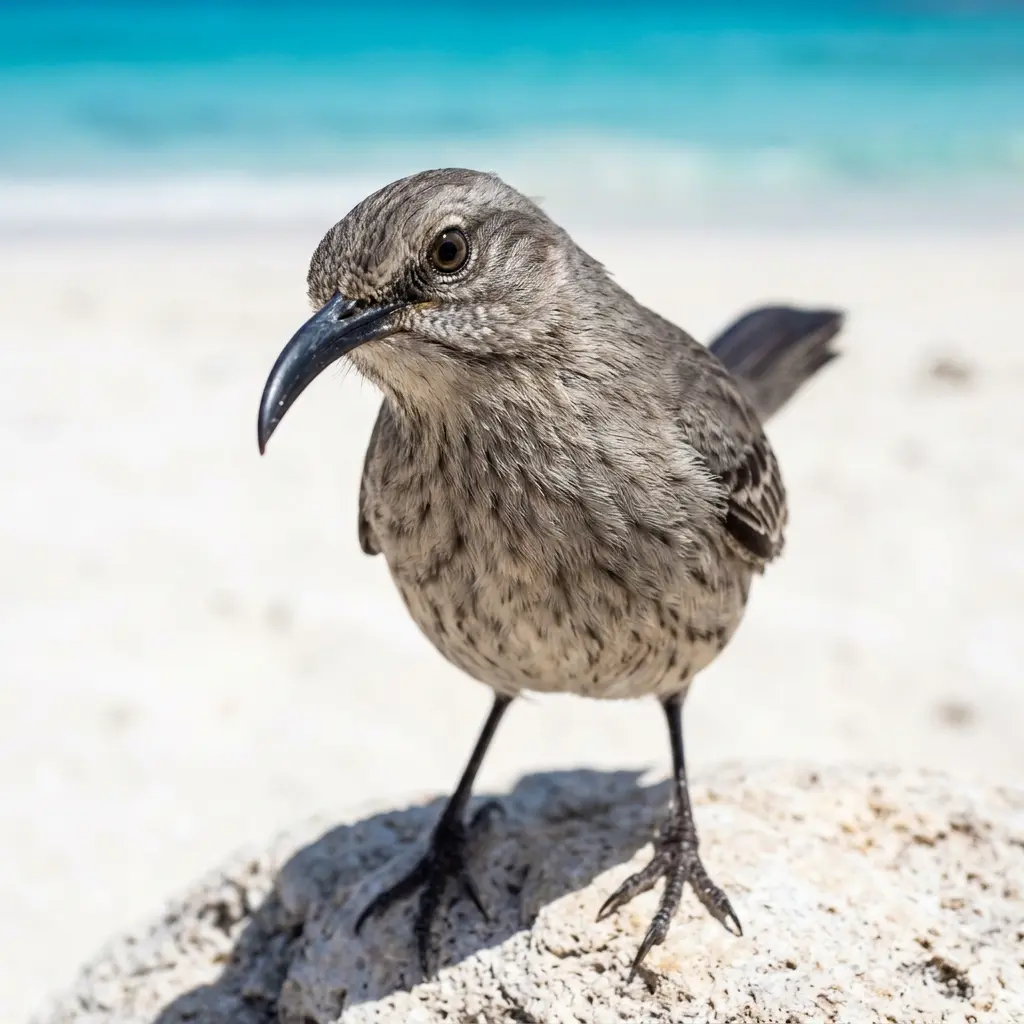
You step off the dinghy on Española, and before you have even put your shoes back on, a grey-brown bird with a long curved beak hops over to look at you. It checks your bag, pecks at your laces and eyes your water bottle. The Galápagos mockingbirds are among the most curious birds in the islands, and they played a key role in one of the biggest ideas in science.
Quick facts
| Fact | Galápagos mockingbirds |
|---|---|
| Scientific names | Mimus parvulus, M. macdonaldi, M. melanotis and M. trifasciatus |
| Endemic | Yes, all four species live only in the Galápagos |
| Size | Around 25 to 30 cm long |
| Diet | Insects, seeds, cactus fruit and flowers, eggs and carrion |
| Conservation status | From Least Concern (Galápagos mockingbird) to Endangered (Floreana and San Cristóbal mockingbirds) |
| Best places | Española, Santa Fe, Genovesa, Santa Cruz and San Cristóbal |
| Best time | All year round |
Darwin’s first clue
Darwin’s finches are more famous, but it was the mockingbirds that first caught Darwin’s attention. In 1835 he noticed that the mockingbirds of Floreana, San Cristóbal and Santiago were different from each other, and in his notes he wrote that if such differences were real, they could undermine the idea that species never change. Unlike with the finches, he had labelled which island each mockingbird came from, and this helped him to see the pattern later.
Four species, four homes
- Galápagos mockingbird: the most widespread, found on many islands, including Santa Cruz, Santa Fe, Genovesa, Isabela and Fernandina.
- Española mockingbird: only on Española, with a longer, curved beak; the boldest of all, famous for checking visitors’ belongings.
- San Cristóbal mockingbird: only on San Cristóbal, now Endangered.
- Floreana mockingbird: it disappeared from Floreana itself and now survives only on the tiny islets of Champion and Gardner-by-Floreana; it is one of the rarest birds in the islands.
Bold and clever
Mockingbirds eat almost anything: insects, seeds, cactus fruit, eggs and even carrion, such as the remains of dead sea lions. On dry islands with little fresh water, the Española mockingbird is attracted to water bottles, which is why guides ask you to keep them closed. They often live in family groups, with older offspring helping to defend the territory and feed the new chicks, and they make loud calls to warn each other of danger, such as the Galápagos hawk.
Where to see Galápagos mockingbirds
- Española: at Punta Suárez and Gardner Bay, the Española mockingbird will often come to meet you on the beach, on the southern islands.
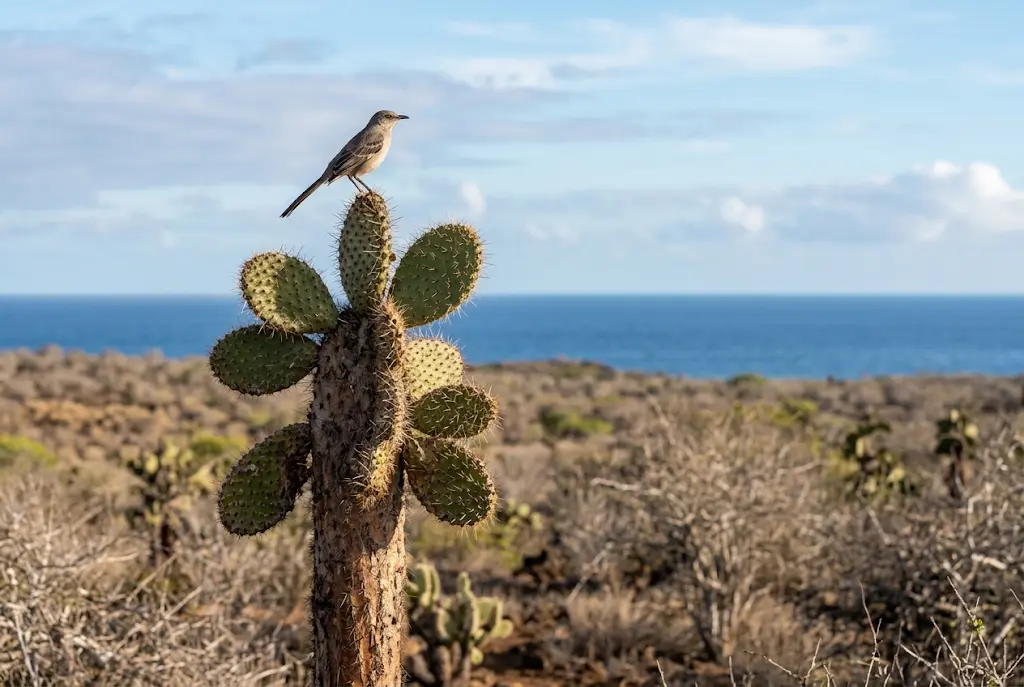
- Santa Fe and Santa Cruz: the Galápagos mockingbird is common among the prickly pear cactus, on the central islands.
- Genovesa: mockingbirds live among the boobies and frigatebirds, on the northern routes.
- Champion islet, Floreana: the rare Floreana mockingbird can sometimes be spotted from the dinghy.
To find the yachts whose routes include these sites, see cruises by island, or locate each one on the interactive map.
Best time to see them
Mockingbirds can be seen all year round. They breed mostly in the warm and rainy season, from January to May, when food is plentiful, and the family groups are especially active and noisy. Check the Galápagos wildlife calendar and our guide to the best time to visit.
Bringing the Floreana mockingbird home
The Floreana mockingbird vanished from Floreana in the late 1800s, after the arrival of people, rats and cats. Only a few hundred birds survive on two nearby islets. A large restoration project has been removing introduced predators from Floreana, with the aim of returning the mockingbird to the island where Darwin first saw it.
Tips for your visit
- Keep your bottle closed. On Española especially, mockingbirds will try to drink from open bottles or peck at bags.
- Get your camera ready on the beach. They often come very close as soon as you land.
- Compare the islands. Ask your guide to point out the differences between mockingbirds on different islands, just as Darwin did.
How to watch them responsibly
- Never give them water or food, even if they ask for it.
- Keep at least two metres away, and step back if they come closer.
- Keep your bags closed and do not leave anything on the ground.
- Stay on the marked trail and follow your naturalist guide.
Frequently asked questions
How many mockingbird species live in the Galápagos?
Four, all endemic: the Galápagos, Española, San Cristóbal and Floreana mockingbirds.
Why are the Galápagos mockingbirds important?
Their differences between islands were one of Darwin’s first clues that species can change over time.
Where can I see the Española mockingbird?
Only on Española, at sites such as Punta Suárez and Gardner Bay.
Why do mockingbirds come so close?
They are naturally curious and bold, and on dry islands they look for water and food.
Can I see the Floreana mockingbird?
Rarely. It lives only on two islets near Floreana, where landing is not allowed, but it can sometimes be seen from the dinghy at Champion.
More Galápagos animals
Along the same trails you will see Darwin’s finches, lava lizards and waved albatrosses. Discover all of them, with the islands and months to see each one, in our guide to Galápagos animals.
Yachts that visit them
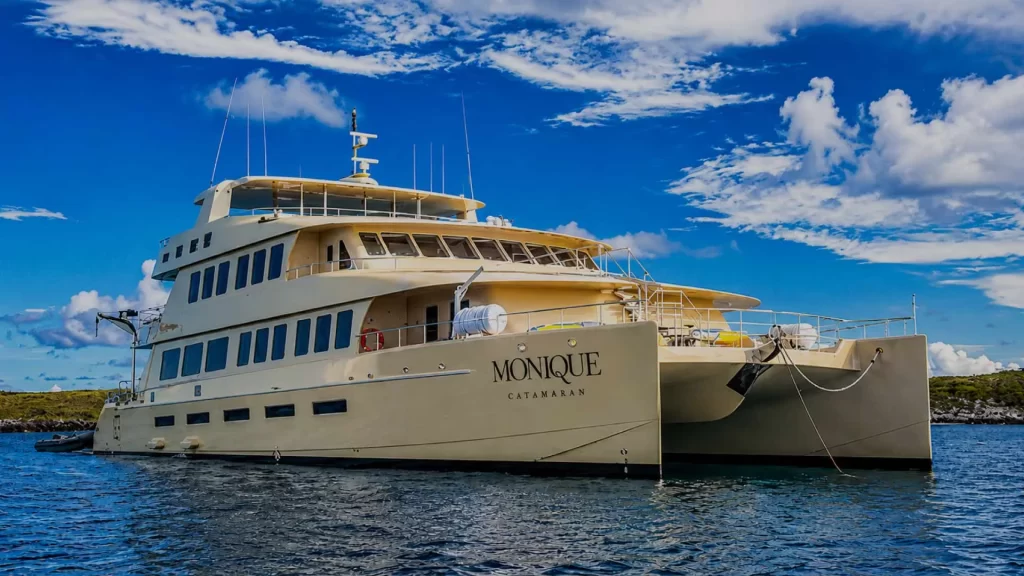
M/C Monique
A 2026 hybrid catamaran for 16 guests, with ocean-view suites, an open-air jacuzzi and a near one-to-one crew.
From USD 7,500
View yacht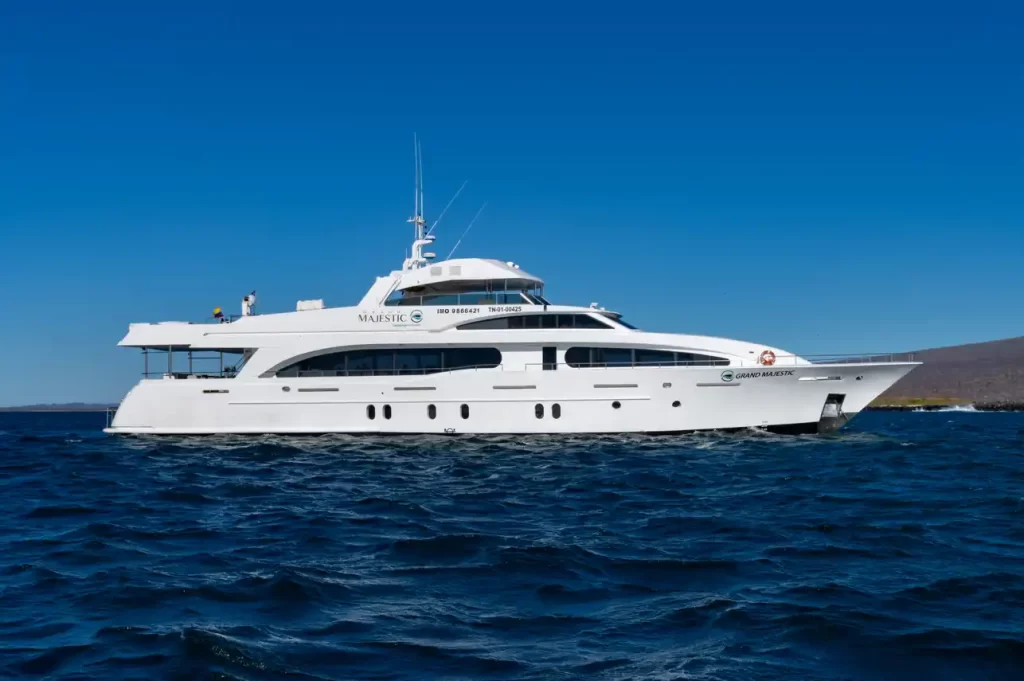
M/Y Grand Majestic
A 39-metre US-designed luxury motor yacht, launched in 2018 and reaching 25 knots, with a 39 m² master suite, seven staterooms and…
Private charter On request
View yacht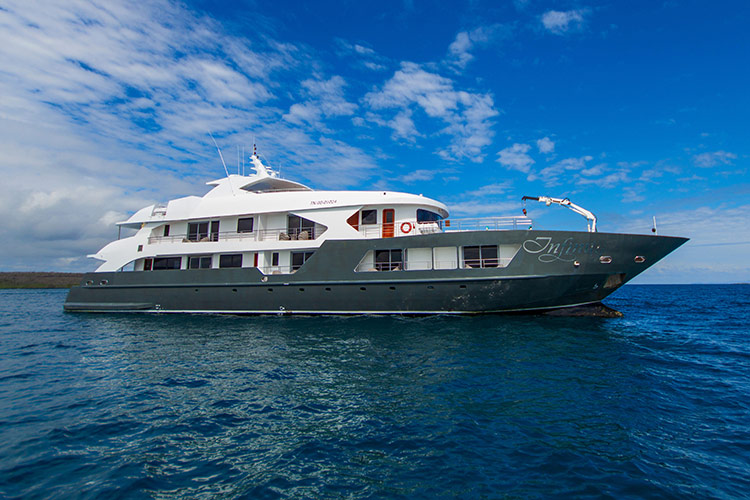
M/Y Infinity Expedition
A 49-metre luxury motor yacht launched in 2018, with eight double cabins and two suites, all with private balconies, a jacuzzi and…
Private charter On request
View yacht