
Galápagos Hawk: The Fearless Hunter of the Islands
The top land predator of the Galápagos, and so unafraid of people that it often lands a few metres away: what it hunts, how several males share one female, where to see it and why it has disappeared from some islands.
4 min read

On the trail at Punta Suárez, a large dark bird of prey sits on a boulder just beside the path. It turns its head, looks at the group, and simply stays where it is. In 1835 Charles Darwin was amazed at how tame these hawks were; almost two centuries later, the Galápagos hawk is still one of the boldest birds you will ever meet, and one of the most exciting to see up close.
Quick facts
| Fact | Galápagos hawk |
|---|---|
| Scientific name | Buteo galapagoensis |
| Endemic | Yes, found only in the Galápagos |
| Size | Around 50 to 60 cm long, with a wingspan of more than 1.2 m; females are larger than males |
| Diet | Lava lizards, young iguanas, centipedes, rats, chicks and carrion |
| Population | Only a few hundred birds |
| Conservation status | Vulnerable (IUCN) |
| Best places | Española, Fernandina, Santa Fe, Isabela and Santiago |
| Best time | All year round |
The king of the land
There are no native land mammals that hunt in the Galápagos, and no other large daytime bird of prey, so the hawk sits at the top of the food chain. It hunts lava lizards, giant centipedes, rats, young marine iguanas and land iguanas, and seabird chicks, and it also feeds on carrion, such as dead sea lions, fish or the afterbirth of newborn pups. It hunts by watching from a high perch or by soaring slowly over the lava and the coast.
One female, several males
The Galápagos hawk has one of the most unusual family lives of any bird of prey. On many islands, one female mates with two or more males, sometimes many more, and all of them defend the territory together and help to feed the chicks. This is called cooperative polyandry. The group usually raises one chick per nest, and young hawks, which are paler and mottled brown, spend a few years wandering before they can join a territory of their own.
How to recognise it
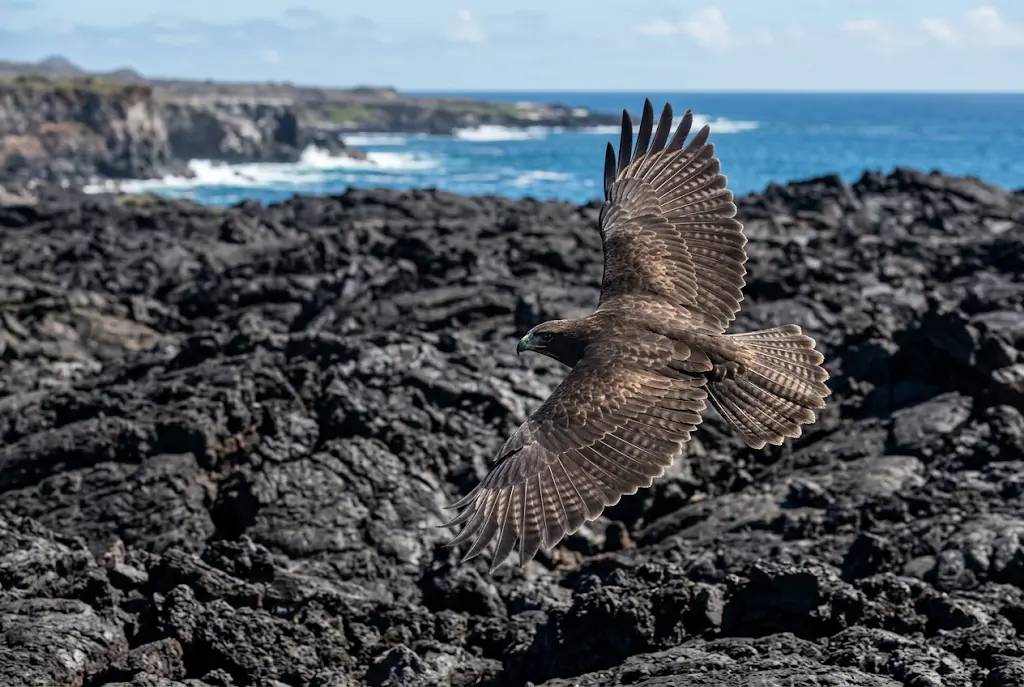
Adults are dark chocolate brown, almost black, with a slightly paler, barred tail, yellow legs and a yellow base to the hooked beak. Young birds are much lighter, with brown and cream mottled plumage. In flight, its broad wings and short, rounded tail are typical of a buzzard-type hawk. It is the only hawk on the islands, so if you see a large bird of prey by day, it is almost certainly a Galápagos hawk.
Where to see Galápagos hawks
- Española: at Punta Suárez and Gardner Bay hawks often perch on rocks along the trail, among waved albatrosses and boobies, on the southern islands.
- Fernandina and western Isabela: Punta Espinoza and Urbina Bay are good places to see them watching over the marine iguana colonies, on the western routes.
- Santa Fe and Santiago: hawks are common at Santa Fe and around Puerto Egas on Santiago, on the central islands.
To find the yachts whose routes include these sites, see cruises by island, or locate each one on the interactive map.
Best time to see them
Galápagos hawks live on the islands all year round and do not migrate. They can breed in any month, though nesting is often more active in the warm season. Check the Galápagos wildlife calendar and our guide to the best time to visit.
Gone from some islands
The hawk once lived on almost every large island, but it has disappeared from Santa Cruz, San Cristóbal and Floreana, where people hunted it and where introduced animals changed the land. Today only a few hundred birds remain, and the species is listed as Vulnerable. Removing rats and goats from several islands has helped, and on some islands the hawk is now seen again more often.
Tips for your visit
- Look up at the high points. Hawks like rocks, cliffs and dead branches with a wide view; scan them as you walk.
- Keep your camera ready. A hawk may land very close without warning, often a perfect chance for a portrait.
- Choose the right islands. If you want to see hawks, check that your route includes Española, Fernandina, Santa Fe or Santiago.
How to watch them responsibly
- Keep at least two metres away, even if the hawk lets you come closer.
- Never offer food or try to attract it.
- Do not approach nests, usually on trees or rocky ledges.
- Stay on the marked trail and follow your naturalist guide.
Frequently asked questions
Is the Galápagos hawk endemic?
Yes. It lives only in the Galápagos and is the only hawk on the islands.
Where can I see the Galápagos hawk?
The best places are Española, Fernandina, western Isabela, Santa Fe and Santiago.
Why are Galápagos hawks so tame?
They evolved with no large predators and little contact with people, so they never learned to fear humans.
What does the Galápagos hawk eat?
Lava lizards, young iguanas, centipedes, rats, seabird chicks and carrion.
How many Galápagos hawks are there?
Only a few hundred, which is why it is listed as Vulnerable.
More Galápagos animals
Where the hawks hunt you will also see mockingbirds, Darwin’s finches and Sally Lightfoot crabs. Discover all of them, with the islands and months to see each one, in our guide to Galápagos animals.
Yachts that visit them

M/C Monique
A 2026 hybrid catamaran for 16 guests, with ocean-view suites, an open-air jacuzzi and a near one-to-one crew.
From USD 7,500
View yacht
M/Y Grand Majestic
A 39-metre US-designed luxury motor yacht, launched in 2018 and reaching 25 knots, with a 39 m² master suite, seven staterooms and…
Private charter On request
View yacht
M/Y Infinity Expedition
A 49-metre luxury motor yacht launched in 2018, with eight double cabins and two suites, all with private balconies, a jacuzzi and…
Private charter On request
View yacht