
Red-Billed Tropicbird: The Long-Tailed Bird of the Galápagos Cliffs
A white seabird with a coral-red beak and two tail streamers longer than its body: how to recognise the red-billed tropicbird, why it can hardly walk, where it nests in the cliffs and the best places to watch it fly.
4 min read

Standing on the cliffs of South Plaza, you hear a sharp, high scream and look up. A white bird flies past at eye level, fast and straight, with two thin tail feathers streaming behind it like ribbons. Then another follows, and another, calling as they circle the cliff. The red-billed tropicbird is one of the most elegant birds in the Galápagos, and watching a group in flight is one of the small joys of a visit to the cliffs.
Quick facts
| Fact | Red-billed tropicbird |
|---|---|
| Scientific name | Phaethon aethereus |
| Endemic | No; it lives in tropical seas of the Atlantic, Pacific and Indian Oceans |
| Size | Around 45 to 50 cm long, plus tail streamers that can add another 50 cm |
| Diet | Flying fish and squid, caught by diving from the air |
| Conservation status | Least Concern (IUCN) |
| Best places | South Plaza, Genovesa and Española |
| Best time | All year round |
How to recognise it
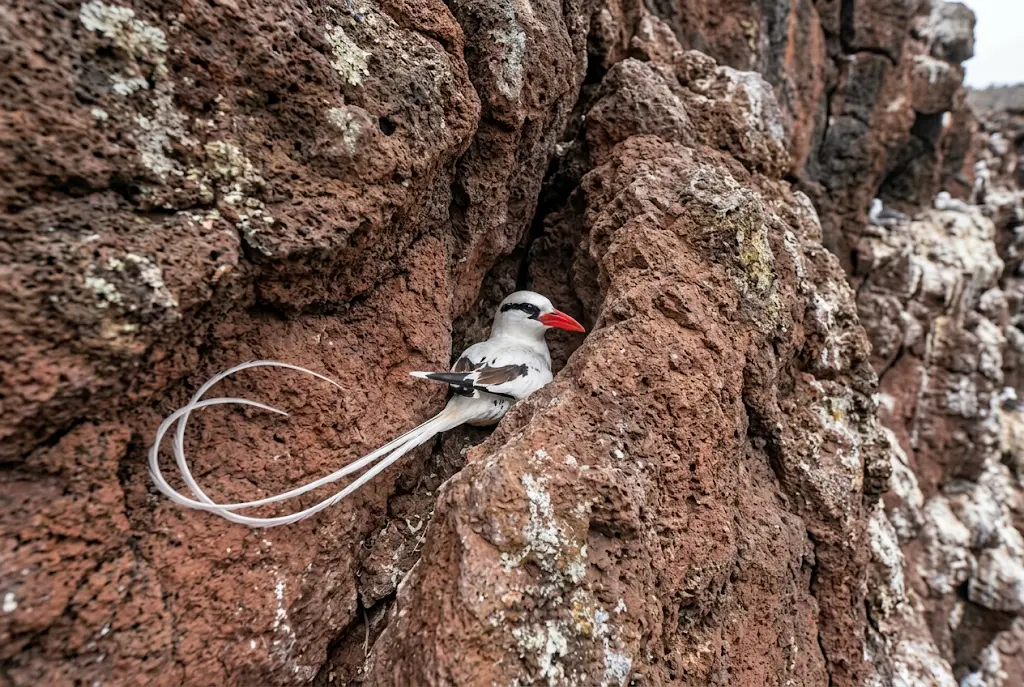
The red-billed tropicbird is mostly white, with a bright coral-red beak and a black stripe through the eye. The back and the top of the wings are finely barred with black, and the tips of the wings are black. Its most striking feature is the pair of long, thin white central tail feathers, which can be as long as the bird itself. Young birds have a yellow beak and no streamers. In flight it beats its wings quickly, more like a pigeon than a gliding seabird, and it often calls with a loud, piercing scream.
A bird made for the air
Tropicbirds spend most of their lives over the open sea, flying far from land to hunt. They find fish and squid from the air, then fold their wings and plunge into the water, often catching flying fish near the surface. Their legs are set so far back on the body that they can barely walk: on land they shuffle forward on their bellies. That is why they nest in cliffs, where they can drop straight into the air from the entrance of the nest.
Life in the cliffs
Each pair nests in a crack, hole or ledge in a cliff, often close to other pairs. The female lays a single egg directly on the rock, and both parents take turns incubating it and feeding the chick. Pairs perform courtship flights in small groups, flying in circles along the cliff and calling loudly. Competition for good nest holes is strong, and pairs sometimes fight over them. In the Galápagos they can breed in any month, so you can often see eggs, chicks and courtship flights on the same visit.
Where to see red-billed tropicbirds
- South Plaza: the cliff at the end of the trail is one of the best places in the islands to watch tropicbirds fly in and out of their nests, next to swallow-tailed gulls, on the central islands.
- Genovesa: tropicbirds nest in the cliffs of Darwin Bay and near Prince Philip’s Steps, among frigatebirds and boobies, on the northern routes.
- Española: at Punta Suárez they fly along the cliffs near the famous blowhole, on the southern islands.
To find the yachts whose routes include these sites, see cruises by island, or locate each one on the interactive map.
Best time to see them
Red-billed tropicbirds are present all year round, and since they can breed in any month, the cliffs are rarely empty. They are often most active in the morning and late afternoon, when the courtship flights are frequent. Check the Galápagos wildlife calendar and our guide to the best time to visit.
Tips for your visit
- Listen for the scream. Their loud call usually announces them before you see them, so look up when you hear it.
- Use a fast shutter speed. Tropicbirds fly quickly; a fast shutter and continuous focus help you catch the tail streamers sharp.
- Look into the cracks. On South Plaza you can sometimes spot an adult or a chick resting inside a hole in the cliff.
How to watch them responsibly
- Stay behind the edge of the cliff and on the marked trail.
- Never lean into or reach toward a nest hole.
- Do not use flash on birds in their nests.
- Follow your naturalist guide and the rules of each visitor site.
Frequently asked questions
Where can I see red-billed tropicbirds in the Galápagos?
The best places are the cliffs of South Plaza, Genovesa and Española.
Why does the tropicbird have such a long tail?
The long tail streamers are used in courtship flights; both males and females have them.
Can tropicbirds walk?
Barely. Their legs are set far back on the body, so on land they shuffle on their bellies, which is why they nest in cliffs.
What do red-billed tropicbirds eat?
Mainly flying fish and squid, caught by diving from the air into the sea.
Is the red-billed tropicbird endemic to the Galápagos?
No. It lives in tropical seas around the world, but the Galápagos is one of the easiest places to see it up close.
More Galápagos animals
On the same cliffs you will see Nazca boobies, short-eared owls and land iguanas. Discover all of them, with the islands and months to see each one, in our guide to Galápagos animals.
Yachts that visit them

M/C Monique
A 2026 hybrid catamaran for 16 guests, with ocean-view suites, an open-air jacuzzi and a near one-to-one crew.
From USD 7,500
View yacht
M/Y Grand Majestic
A 39-metre US-designed luxury motor yacht, launched in 2018 and reaching 25 knots, with a 39 m² master suite, seven staterooms and…
Private charter On request
View yacht
M/Y Infinity Expedition
A 49-metre luxury motor yacht launched in 2018, with eight double cabins and two suites, all with private balconies, a jacuzzi and…
Private charter On request
View yacht