
Short-Eared Owl in the Galápagos: The Owl That Hunts by Day
An owl that hunts in broad daylight among thousands of seabirds: how the short-eared owl of Genovesa catches storm petrels, where to look for it, how to spot it on the lava and the best moments for your visit.
4 min read
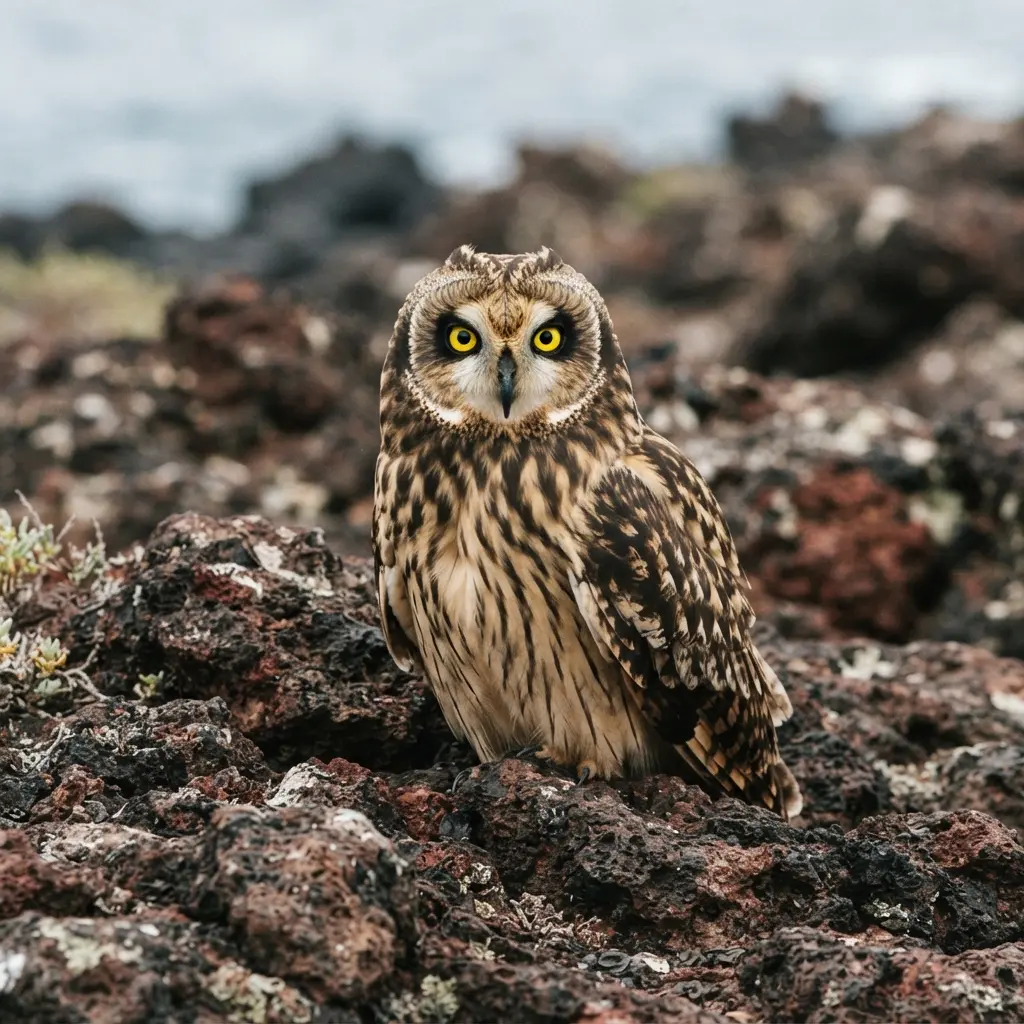
On the lava plateau of Genovesa, thousands of small dark storm petrels fly in and out of cracks in the rock. Among them, something brown and still sits on the lava, almost invisible until it turns its head and shows two bright yellow eyes. It is a short-eared owl, and here, unlike almost anywhere else, it hunts in broad daylight.
Quick facts
| Fact | Short-eared owl |
|---|---|
| Scientific name | Asio flammeus galapagoensis |
| Endemic | The species lives on several continents; this subspecies lives only in the Galápagos |
| Size | Around 35 to 40 cm long |
| Diet | Storm petrels and other small birds, rodents and insects |
| Conservation status | Least Concern (IUCN, species) |
| Best place | Genovesa, at Prince Philip’s Steps (El Barranco) |
| Best time | All year round |
Why does it hunt by day?
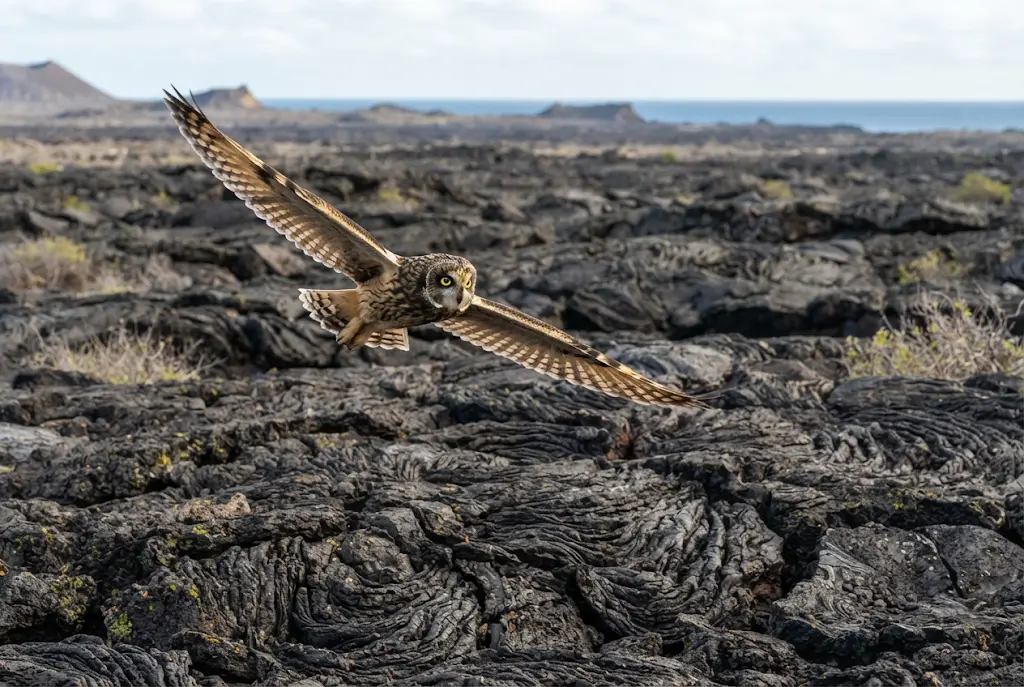
Short-eared owls hunt at dusk or at night on most islands, especially where the Galápagos hawk is present, since the hawk is a larger daytime predator. Genovesa has no hawks, and its lava is home to huge colonies of storm petrels that fly in and out of their nests in cracks all day long. With no competition and plenty of prey, the owls have learned to hunt in daylight. They wait near the cracks or fly low over the lava, then pounce on petrels as they come and go.
How to recognise it
The short-eared owl of the Galápagos is darker than those on the mainland, with brown plumage streaked with cream and black that blends perfectly with the lava. Its face is round and pale, with a dark mask around large yellow eyes. The small “ears” that give it its name are just tufts of feathers and are rarely visible. In flight, its long wings and slow, soft wing beats, almost like a large moth, make it easy to recognise.
Where to see short-eared owls
- Prince Philip’s Steps (El Barranco), Genovesa: a trail crosses the lava plateau where owls hunt storm petrels, passing nesting Nazca boobies and red-footed boobies, on the northern routes.
- Darwin Bay, Genovesa: owls are sometimes seen along the trail near the cliffs.
- Other islands: on Santa Cruz, San Cristóbal and other islands the owls are present, but they are harder to see, as they are mostly active at dusk.
To find the yachts whose routes include Genovesa, see cruises by island, or locate it on the interactive map.
Best time to see them
Owls live on Genovesa all year round, and since the storm petrels nest there constantly, they hunt in every month. Morning visits are often good, but there is no fixed time: it is mostly a matter of looking carefully. Check the Galápagos wildlife calendar and our guide to the best time to visit.
Another owl in the Galápagos
The islands also have a barn owl, a small, pale subspecies that hunts only at night and is much harder to see. If your guide mentions owls in the highlands of Santa Cruz or Isabela, it may be either of the two species, but on Genovesa, in daylight, you are looking at a short-eared owl.
Tips for your visit
- Choose a route with Genovesa. It is the best place in the islands to see this owl, so check that your itinerary includes Prince Philip’s Steps.
- Look at the lava, not the sky. Owls often sit perfectly still on the ground, almost invisible; scanning the rocks slowly is the key.
- Be patient. If you find one, stay still for a few minutes: you may see it fly or hunt.
How to watch them responsibly
- Keep at least two metres away from the owl, even if it does not move.
- Do not chase it or try to make it fly for a photo.
- Stay on the marked trail, as the cracks in the lava are full of nests.
- Follow your naturalist guide and the rules of each visitor site.
Frequently asked questions
Are there owls in the Galápagos?
Yes. There are two: the short-eared owl, which can hunt by day, and the barn owl, which hunts only at night.
Where can I see the short-eared owl in the Galápagos?
The best place is Prince Philip’s Steps (El Barranco) on Genovesa, on the northern routes.
Why does the short-eared owl hunt by day on Genovesa?
Because there are no hawks on the island and its lava is full of storm petrels that fly in and out all day.
What does the short-eared owl eat?
On Genovesa mostly storm petrels; on other islands also rodents, insects and other small birds.
Is it easy to see?
Not always: its plumage blends with the lava, so you need patience and a good guide.
More Galápagos animals
On the same island you will see frigatebirds, swallow-tailed gulls and red-billed tropicbirds. Discover all of them, with the islands and months to see each one, in our guide to Galápagos animals.
Yachts that visit them

M/C Monique
A 2026 hybrid catamaran for 16 guests, with ocean-view suites, an open-air jacuzzi and a near one-to-one crew.
From USD 7,500
View yacht
M/Y Grand Majestic
A 39-metre US-designed luxury motor yacht, launched in 2018 and reaching 25 knots, with a 39 m² master suite, seven staterooms and…
Private charter On request
View yacht
M/Y Infinity Expedition
A 49-metre luxury motor yacht launched in 2018, with eight double cabins and two suites, all with private balconies, a jacuzzi and…
Private charter On request
View yacht