
Galápagos Flamingos: Pink Birds of the Salt Lagoons
Flamingos on volcanic islands: where to find them in the quiet brackish lagoons of the Galápagos, why they are so pink, how they feed upside down and why this small population needs a light footstep.
4 min read
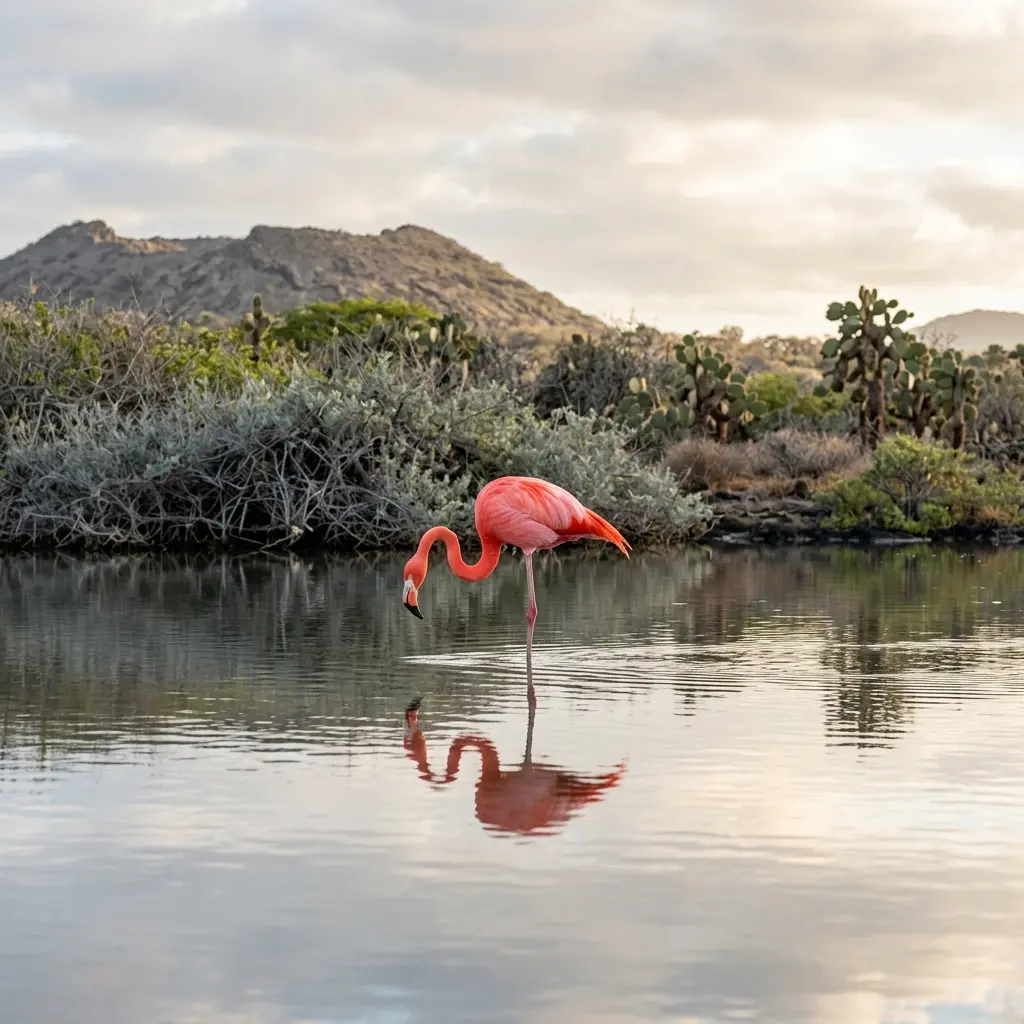
After a morning of lava, sea lions and boobies, the sight of a bright pink bird standing in a still lagoon feels almost out of place. Yet a small population of flamingos lives in the Galápagos, scattered across the brackish lagoons that sit just behind some beaches. They are never in large flocks here: a few birds, sometimes a few dozen, walking slowly through shallow water with their heads down, reflected on the surface.
Quick facts
| Fact | Galápagos flamingo |
|---|---|
| Scientific name | Phoenicopterus ruber (American flamingo) |
| Endemic | No; the species also lives in the Caribbean, but the Galápagos birds form a small, isolated population |
| Height | Up to about 1.2 to 1.4 m tall |
| Population on the islands | Only a few hundred birds |
| Diet | Brine shrimp, small crustaceans, insect larvae and algae |
| Best places | Floreana, Rábida, Santa Cruz, Isabela and Santiago |
| Best time | All year round |
Why are flamingos pink?
Flamingos are not born pink. The chicks are grey, and the colour comes later from their food: the tiny shrimp and algae they eat contain natural pigments called carotenoids, which build up in their feathers, legs and skin. The more of these pigments a bird eats, the brighter it becomes. The American flamingo is the most intensely coloured of all flamingos, often a deep pink close to orange, which is why they stand out so strongly against the dark lagoons and grey scrub of the islands.
How they feed
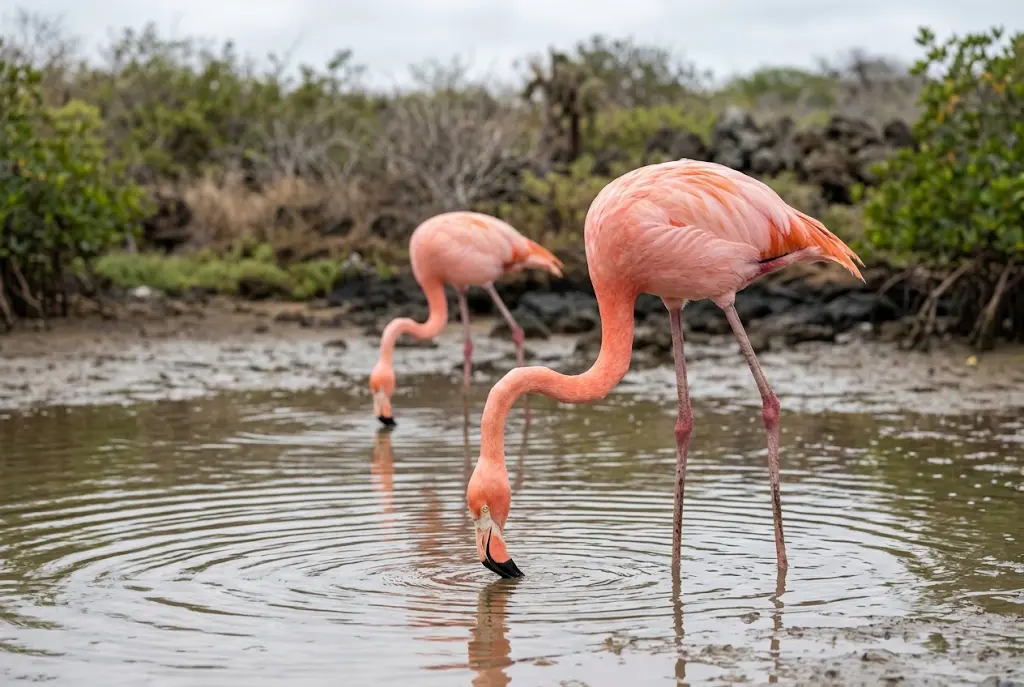
A flamingo feeds with its head upside down. It walks slowly through shallow water, stirs up the mud with its feet and sweeps its bent beak from side to side. Inside the beak, fine plates and a thick tongue work like a sieve, pumping water in and out and trapping tiny shrimp and other small creatures. Because the lagoons of the Galápagos are small and their food is limited, the birds often move between lagoons and even between islands, so the number you see at each site can change from one week to the next.
Where to see flamingos
- Punta Cormorant, Floreana: a short trail leads from a greenish beach to a large lagoon where flamingos are often seen, before reaching a white beach where green sea turtles nest, on the southern islands.
- Rábida: a small lagoon just behind the red beach, where flamingos feed a few steps from resting sea lions.
- Dragon Hill, Santa Cruz: lagoons on the way to a hill known for its land iguanas, on the central islands.
- Puerto Villamil, Isabela: lagoons on the edge of the village, easy to reach on foot.
- Espumilla, Santiago: a lagoon behind the beach where flamingos are sometimes seen.
To find the yachts whose routes include these sites, see cruises by island, or locate each one on the interactive map.
Best time to see them
Flamingos can be seen all year round. They nest on mud mounds at the edge of some lagoons, laying a single egg, and the timing depends on rain and food rather than on a fixed season. Because the birds move around, no site is ever guaranteed, but on a route that includes two or three of these lagoons your chances are very good. Check the Galápagos wildlife calendar and our guide to the best time to visit.
A small and fragile population
As a species, the American flamingo is not threatened, but the birds of the Galápagos are only a few hundred and depend on a handful of small lagoons. Disturbance at the nesting sites, changes in water levels and pollution can easily affect them. That is why lagoons are watched from the trail, and why some, especially those near towns, are closely protected.
Tips for your visit
- Bring binoculars. Flamingos often feed in the middle or on the far side of the lagoon, and binoculars make a big difference.
- Keep your voice down. Flamingos are shy compared with other Galápagos animals; walking quietly keeps them feeding.
- Use a long lens. A zoom of 200 mm or more lets you capture their colour and reflection without getting closer.
How to watch them responsibly
- Always stay on the marked trail around the lagoons.
- Never walk into the lagoon or on its muddy edges, where they may nest.
- Do not make sudden noises or movements to make them fly.
- Follow your naturalist guide and the rules of each visitor site.
Frequently asked questions
Are there flamingos in the Galápagos?
Yes. A small population of American flamingos lives in the brackish lagoons of several islands.
Where can I see flamingos in the Galápagos?
The best places are Punta Cormorant on Floreana, Rábida, Dragon Hill on Santa Cruz and the lagoons of Puerto Villamil on Isabela.
How many flamingos are there in the Galápagos?
Only a few hundred, which makes it one of the smallest flamingo populations in the world.
Why are the Galápagos flamingos so pink?
Because of the natural pigments in the tiny shrimp and algae they eat.
Can I see flamingos on any itinerary?
Not on all. They live in specific lagoons, so check that your route includes sites such as Punta Cormorant, Rábida or Dragon Hill.
More Galápagos animals
Near the same lagoons you can see blue-footed boobies, lava lizards and mockingbirds. Discover all of them, with the islands and months to see each one, in our guide to Galápagos animals.
Yachts that visit them

M/C Monique
A 2026 hybrid catamaran for 16 guests, with ocean-view suites, an open-air jacuzzi and a near one-to-one crew.
From USD 7,500
View yacht
M/Y Grand Majestic
A 39-metre US-designed luxury motor yacht, launched in 2018 and reaching 25 knots, with a 39 m² master suite, seven staterooms and…
Private charter On request
View yacht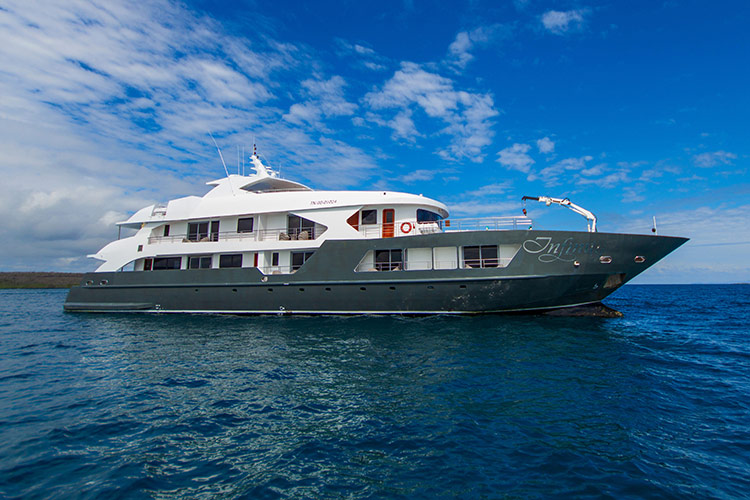
M/Y Infinity Expedition
A 49-metre luxury motor yacht launched in 2018, with eight double cabins and two suites, all with private balconies, a jacuzzi and…
Private charter On request
View yacht